Fish Feed Technical Article
Sinking vs Floating Feed Extruder Settings: Meiteng Manufacturer Guide
Most operators blame the dryer when sinking feed floats, but buoyancy is actually locked in at the extruder die.
Sinking feed floating is rarely a machine defect; it stems from mismatched conditioning steam, excessive gelatinization, or incorrect die compression ratios, requiring precise parameter fine-tuning rather than downstream equipment replacement.
I remember standing next to a twin-screw machine in Can Tho, Vietnam, watching a client refuse to sign the final acceptance document. He was convinced the equipment was incapable of producing sinking pellets because the feed kept drifting to the surface. After monitoring the operation for a couple of days, the root cause became obvious. The conditioning steam was injected too aggressively, causing severe over-gelatinization, and the die compression ratio was completely mismatched for his specific formula. The material was essentially turning into a sponge before it even hit the die. Since that assignment, verifying the alignment between conditioning temperature and screw speed has been my absolute first step on any site visit. Achieving the correct sinking feed extruder settings is never about flipping a single switch; it is entirely about micro-adjusting the thermodynamic balance inside the barrel.

Getting the sinking feed extruder settings right requires understanding that moisture and heat behave differently depending on the target density. Let us break down the exact adjustments needed to keep your pellets at the bottom of the pond.
Why Does Sinking Feed Float Unexpectedly?
Unexpected buoyancy is almost always a symptom of trapped air and expanded starch matrices, not a failure of the drying system.
Many producers assume that floating indicates low moisture content entering the dryer. In reality, over-gelatinization from excess steam traps microscopic air pockets and drastically increases buoyancy before the pellet even exits the die. When steam-to-feed ratios are pushed too high, the starch molecules fully uncoil and bind water so tightly that the expanding vapor cannot escape during the pressure drop at the die face. This creates a cellular structure meant for floating feed, completely ruining the density required for sinking applications.
During a troubleshooting visit at a tilapia farm in East Africa, the production team was running a high-fiber recipe. They kept increasing the dryer temperature to force the pellets down, but the feed continued to float. The issue was not the drying curve; the buoyancy was permanently set the moment the material left the die. The high-fiber ingredients required a completely different thermal profile to prevent the starch from expanding excessively. By simply reducing the thermal energy input and adjusting the mechanical shear, the density returned to the required level.

The core insight here is that you cannot dry a floating pellet into a sinking pellet. The physical structure is finalized at the die. If your sinking feed extruder settings allow too much expansion in the barrel, no amount of downstream drying will fix the buoyancy error.
How to Optimize Conditioning Temperature and Steam?
Precise steam control is the primary defense against over-gelatinization and air entrapment in sinking feed production.
To achieve the correct sinking feed extruder settings, you must limit the thermal energy added during the conditioning phase. The goal is to hydrate the raw materials sufficiently for binding without triggering the full gelatinization that causes expansion.
Follow these steps to optimize your steam and temperature profile:
- Measure the initial moisture: Ensure the raw mix enters the conditioner at a stable, low baseline moisture.
- Reduce steam pressure: Lower the steam pressure to achieve a minimal temperature rise. For sinking feeds, the conditioning temperature should remain noticeably lower than floating feed protocols.
- Monitor the dough texture: The material exiting the conditioner should feel crumbly and cohesive, not sticky or paste-like.
- Adjust steam-to-feed ratio: Decrease the steam injection gradually while observing the motor amperage. A drop in amperage often indicates reduced gelatinization.
On a catfish feed line in Latin America, the operator was using a high-steam floating protocol for a sinking recipe. The dough was literally boiling inside the barrel. By throttling back the steam valve and relying more on mechanical friction for heat, we stopped the starch from turning into a gel. The resulting pellets sank perfectly without needing to alter the dryer settings at all.

Controlling steam addition prevents over-gelatinization and air entrapment, ensuring the starch matrix remains dense enough to sink.
What is the Right Screw Speed and Barrel Setup?
Lowering the screw RPM and managing barrel zone temperatures reduces shear heat to maintain the necessary pellet density.
The correct sinking feed extruder settings demand a careful balance of mechanical energy. High screw speeds generate massive amounts of friction heat, which acts just like steam—it expands the starch and traps air.
To configure the screw and barrel properly:
- Drop the RPM: Reduce the screw speed significantly compared to floating feed runs. This limits the shear heat generated by the metal-on-material friction.
- Configure barrel cooling: Activate water cooling on the middle and metering zones of the barrel. This prevents the friction heat from accumulating and cooking the starch prematurely.
- Adjust screw element profile: Use reverse elements or restrictive flight configurations to build pressure without generating excessive heat.
- Monitor the main motor load: The amperage should be steady. Spikes indicate the material is getting too hot and expanding inside the barrel.
I once worked with a shrimp feed producer in Southeast Asia who was struggling with buoyancy. His screw speed was set to the maximum to achieve high output. The shear heat was so intense that the feed was expanding inside the barrel, creating a porous structure. We lowered the RPM, added barrel cooling, and changed the screw arrangement to focus on pressure rather than shear. The output capacity dropped slightly, but the sink rate became flawless.

Lowering RPM and adjusting barrel zones reduces shear heat to maintain density, preventing the mechanical generation of buoyancy.
How to Match Die Compression Ratios for Sinking Feed?
Selecting the correct L/D ratio and die compression ensures proper density, especially for high-fiber or complex recipes.
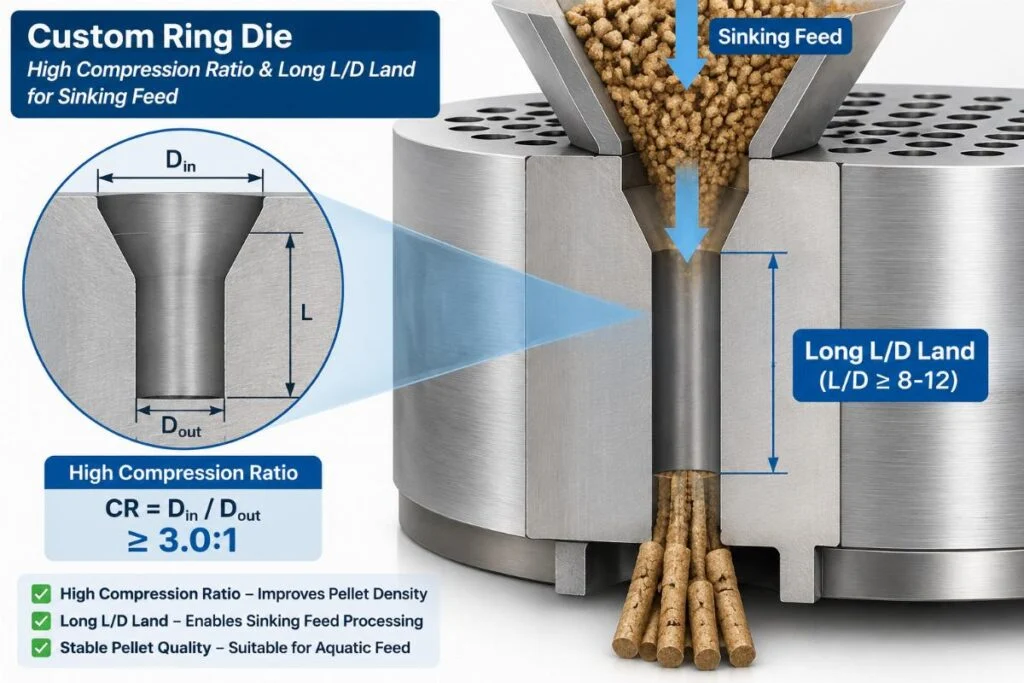
The final piece of the sinking feed extruder settings puzzle is the die itself. A die designed for floating feed has a low compression ratio, allowing the material to expand rapidly as it exits. For sinking feed, you need a high compression ratio to pack the material tightly and prevent any final expansion.
When matching the die:
- Increase the L/D ratio: A longer die land provides more resistance, compressing the dough and eliminating air pockets before the final exit.
- Select high compression profiles: The transition zone from the barrel to the die holes must be gradual but firm to squeeze out trapped gases.
- Account for fiber content: High-fiber formulas require even higher compression because the fibers resist compaction and tend to spring back.
This is exactly where custom engineering becomes critical. When we design a turnkey aquafeed line at Meiteng, we do not just supply a standard machine. We analyze your specific formula and calculate the exact ring die compression required. For a client producing a high-fiber sinking carp feed, our custom ring die design completely eliminated the floating issue that standard dies could not solve. Our technical team handles the production line consulting and formula development to ensure every mechanical parameter aligns with your raw materials.
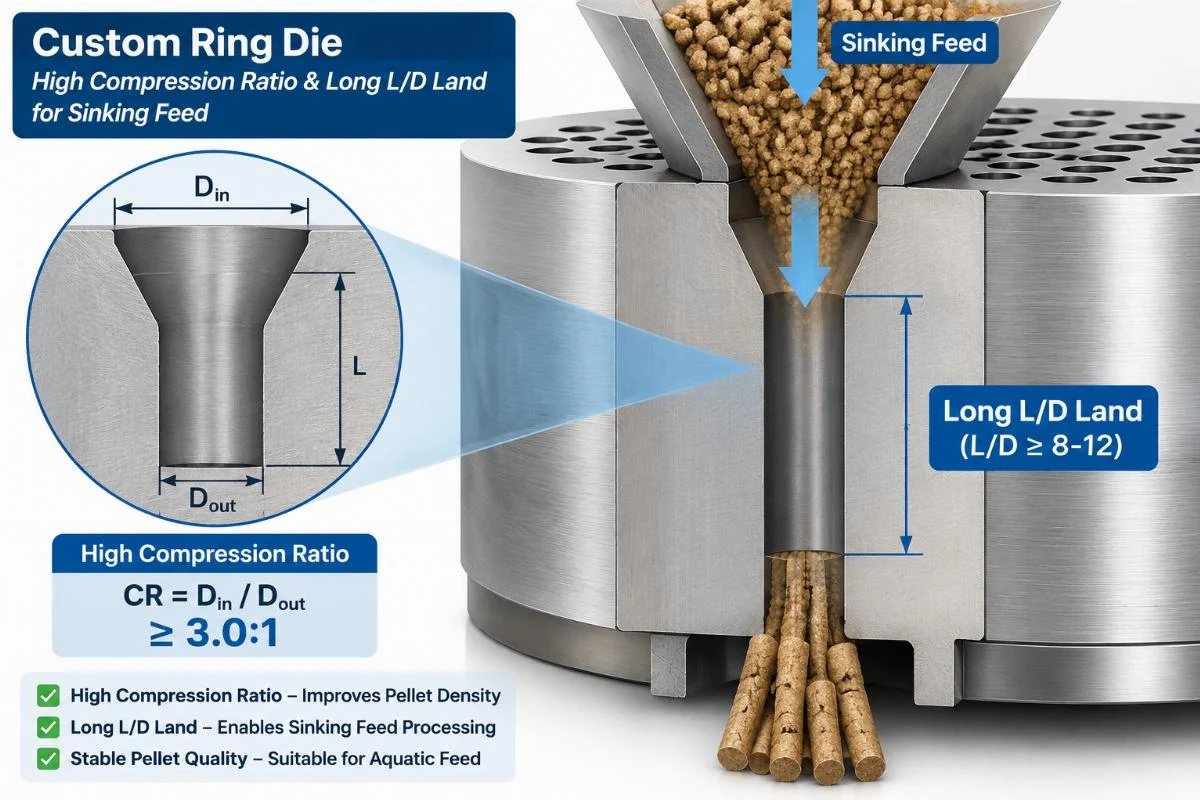
Selecting the correct L/D ratio and compression ensures proper density for high-fiber recipes, locking in the sink rate at the final point of exit.
Conclusion
Buoyancy is forged in the extruder, not the dryer. Mastering sinking feed extruder settings requires strict control over steam, shear heat, and die compression. By treating the entire barrel as a density-building tool rather than just a mixing chamber, producers can consistently achieve the perfect sink rate without fighting downstream equipment.