Fish Feed Technical Article
Shrimp Feed Line Manufacturer: DS70 Extruder for Vietnam & Indonesia
Chasing maximum throughput on a shrimp feed line is the fastest way to ruin your sinking rate and bankrupt your local reputation.
To build a profitable shrimp feed line in Vietnam or Indonesia, you must stop treating extrusion as a simple volume game and start matching twin-screw shear force, conditioning temperature, and ring die L/D ratios to the specific sinking-rate demands of local ponds and the high-humidity realities of the monsoon season.
I still remember the exact smell of starch burning in a workshop in Can Tho. I was standing next to a client who was furious, pointing at a pool where half of the extruded pellets were floating instead of sinking. We had just installed what looked perfect on paper. The theoretical capacity was right, but the actual conditioning temperature dropped during the humid afternoon shift, and the starch gelatinization degree failed. The shrimp feed line produced beautiful pellets, but they were useless in the pond. That afternoon taught me that图纸上的公差救不了现场 (blueprint tolerances cannot save you on the factory floor). When sourcing a shrimp feed line, buyers need to look past the brochure capacity and focus on how the equipment handles the physical transition from raw material to a dense, sinking pellet under tropical stress.
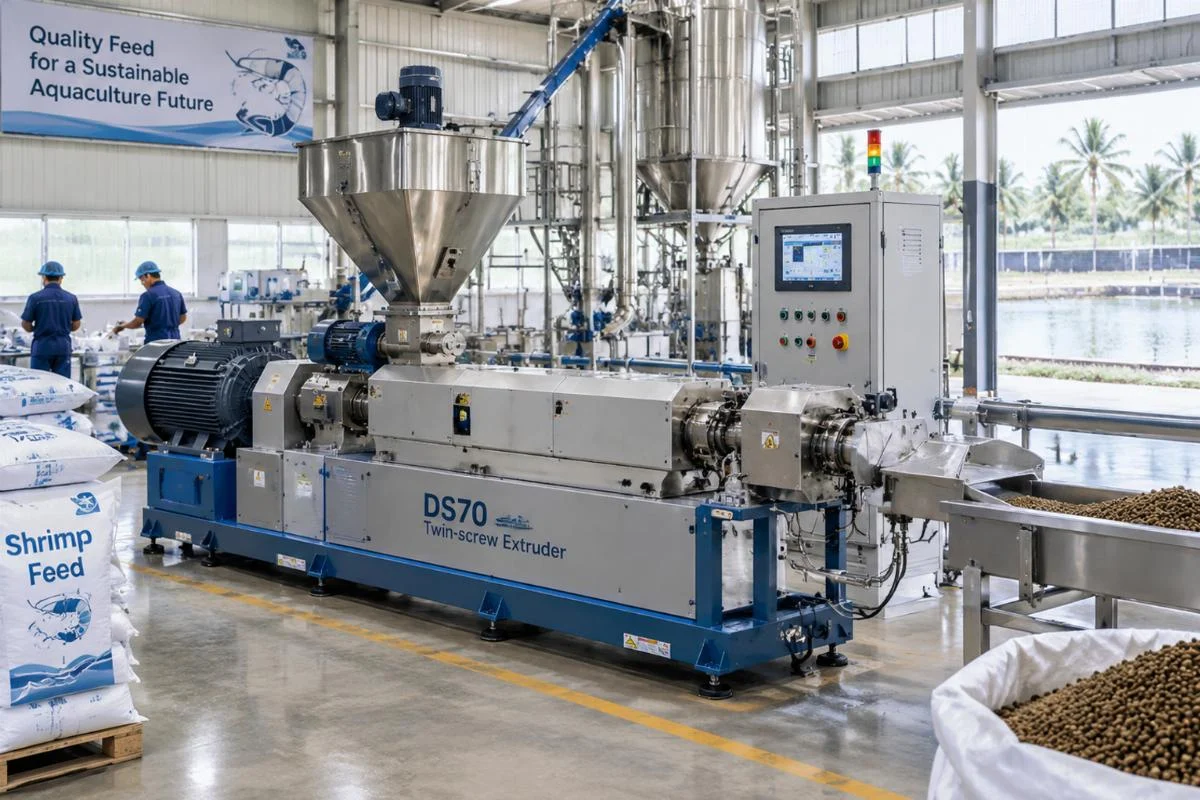
Moving from pilot testing to commercial production requires a deep understanding of how local water quality and farm practices dictate equipment selection. Let us break down the real field mechanics of building a reliable shrimp feed line.
What Extruder Specs Actually Matter for Sinking Shrimp Feed?
The density of a sinking pellet is determined by shear force and residence time inside the barrel, not by the motor size.
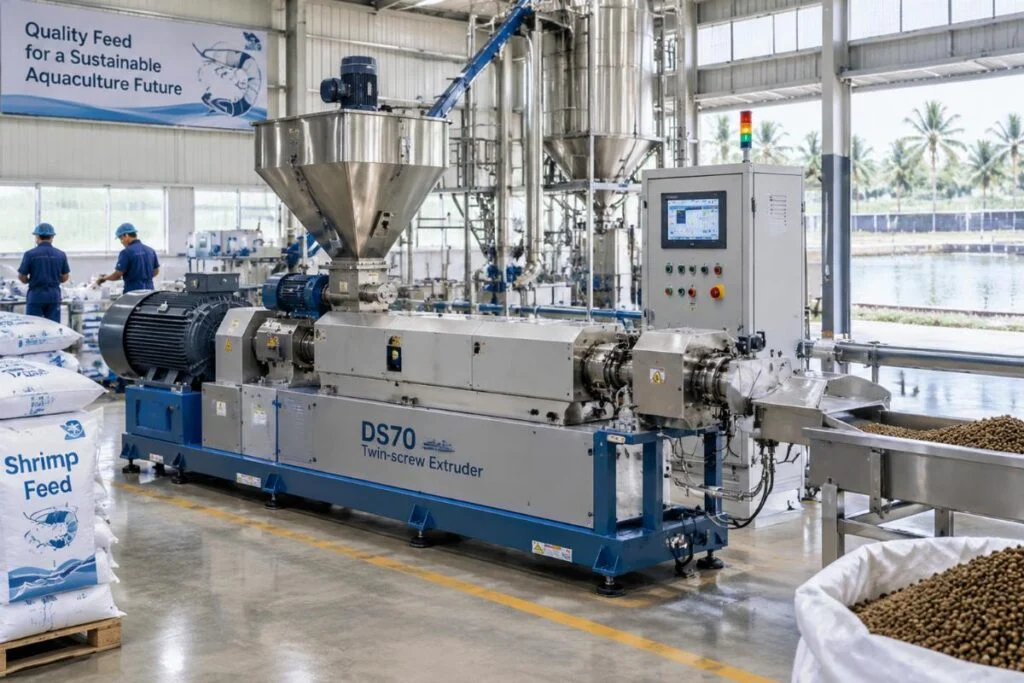
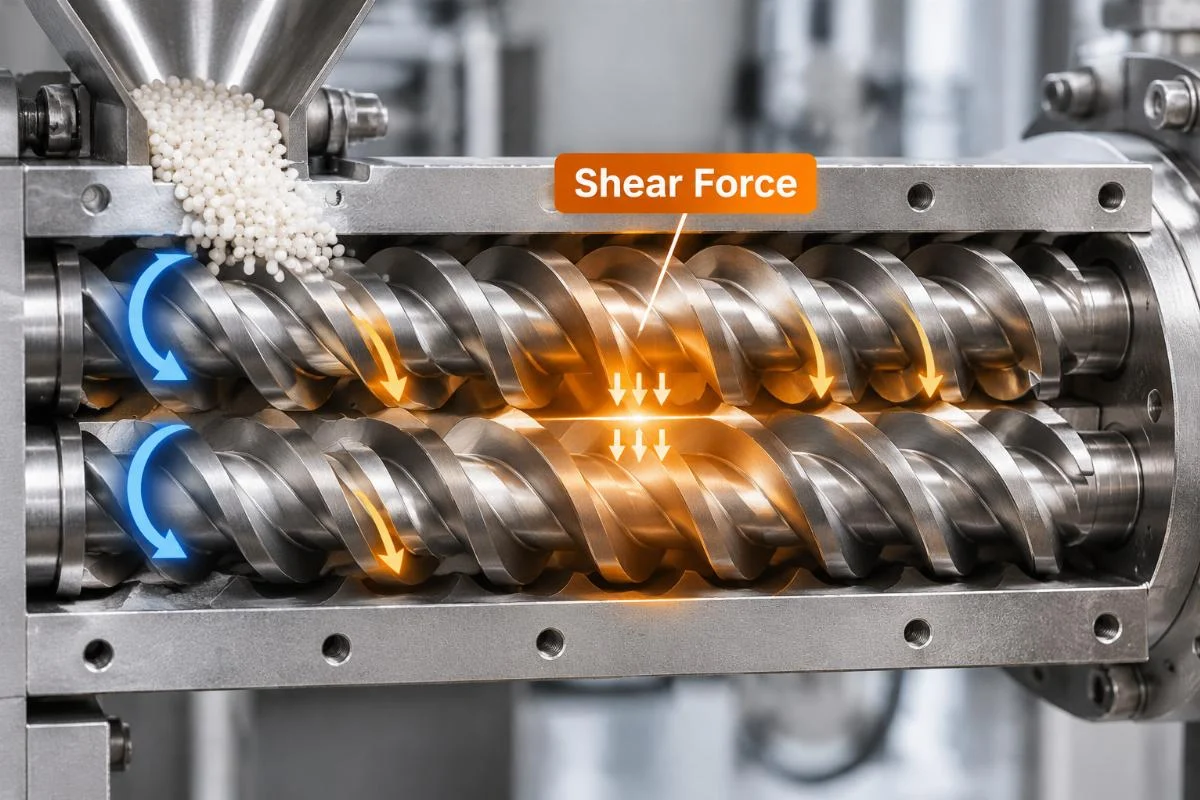
Many buyers assume that a bigger single-screw machine will solve their capacity issues. This is a fundamental misunderstanding of extrusion physics. For a true shrimp feed line targeting sinking pellets, a twin-screw shrimp feed extruder is non-negotiable. The intermeshing screws create a kneading effect that generates consistent shear force, which is critical for collapsing the air cells inside the dough. A single-screw design relies on friction against the barrel wall, which often leaves micro-pores that trap air, causing the pellet to float or suspend in the water column.
When we evaluate extruder specs for a shrimp feed line, the focus must be on the screw configuration and the barrel temperature zones.
| Parameter | Single-Screw Extruder | Twin-Screw Extruder (DS70) |
|---|---|---|
| Shear Force Distribution | Uncontrolled / High variance | Controlled / Uniform kneading |
| Air Cell Collapse | Vulnerable / High floating rate | Robust / High sinking density |
| Starch Gelatinization | Basic / Inconsistent | Full batch-level / Complete |
| Sinking Rate Stability | Uncontrolled | Standard / Verifiable |
A Middle East aquaculture feed producer once tried to save capital by using a single-screw machine for a shrimp feed line. They faced a disaster where the pellet durability index dropped noticeably after a few hours of continuous running, and the sinking rate fluctuated wildly. By switching to a DS70 twin-screw shrimp feed extruder, the shear force was evenly distributed, ensuring that every pellet achieved the necessary density to sink within the required timeframe.
Furthermore, the screw gap and configuration in a twin-screw system allow for precise control over the residence time. If the material stays in the barrel too short, the starch does not fully gelatinize, leading to poor water stability. If it stays too long, the protein denatures. The DS70 allows operators to adjust the screw elements to find the exact sweet spot for high-protein shrimp formulations.
How to Size Your Shrimp Feed Line for Vietnam and Indonesia?
Sizing a shrimp feed line is about matching the local farm density and shift patterns, not just picking the highest number on the catalog.
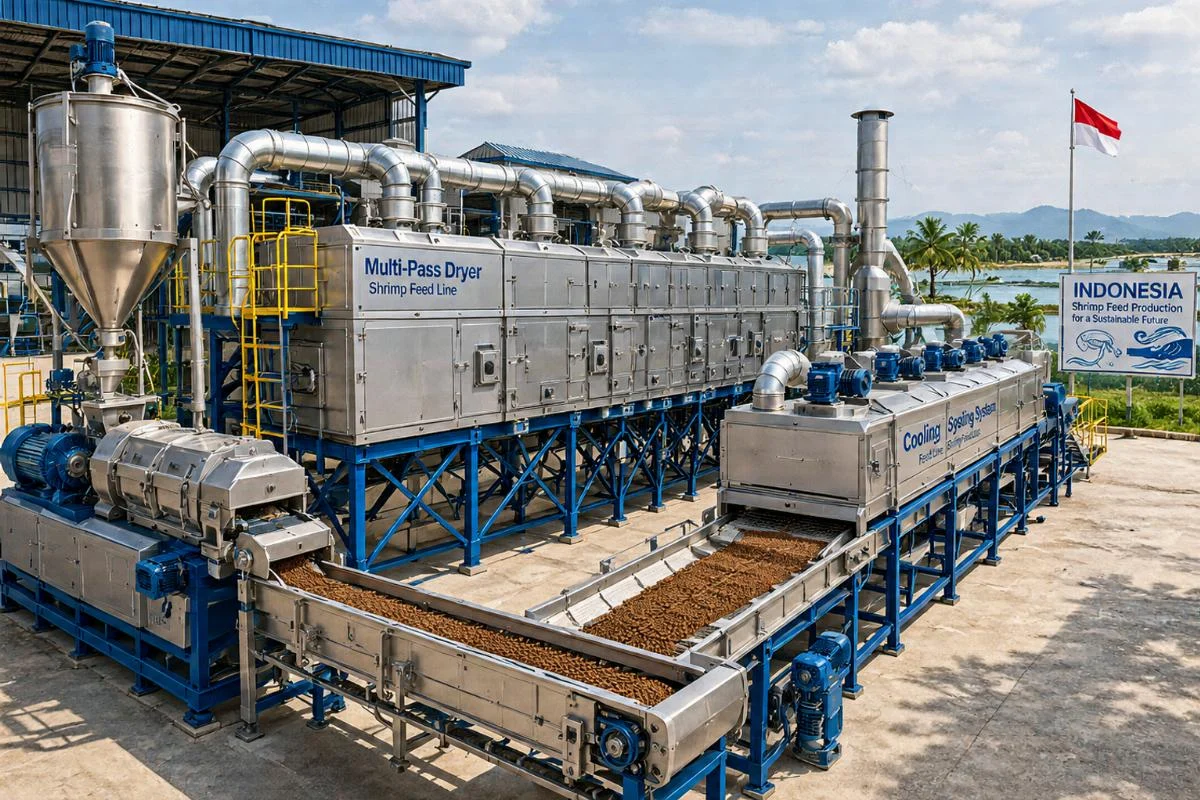
In Vietnam and Indonesia, shrimp farming is highly fragmented, and feed mills often operate on tight margins with specific shift patterns. A common mistake is scaling directly from a pilot line to a massive commercial shrimp feed line without considering the local logistics. A 2000kg/h shrimp feed line might look efficient, but if the local pellet cooling and drying systems cannot handle the sudden moisture spike, the entire batch will be ruined by mold during the monsoon season.
When sizing your shrimp feed line, consider the transition from 200kg/h pilot capacity to commercial volumes. The key is to ensure that the downstream drying and cooling equipment is perfectly synchronized with the extruder output. If the extruder pushes out pellets at a high moisture content, the dryer must have sufficient retention time and airflow to bring the moisture down to a safe level without over-drying.
A European wind farm operator (diversifying into aquaculture feed) once ordered a massive shrimp feed line based on theoretical output. They ignored the local humidity. During the rainy season, the dryer could not keep up, and the pellets absorbed moisture before packaging. The result was a mid-six-figure loss due to spoiled inventory. By recalibrating the shrimp feed line to include a multi-pass dryer with precise humidity control, they stabilized the production.
For the Southeast Asian market, a shrimp feed line in the 500kg/h to 1000kg/h range often provides the best balance. It allows for continuous running without overwhelming the local logistics network, and it gives the drying system enough margin to handle the ambient humidity spikes typical of the region.
Why Do Pellets Fail the Sinking Test in Tropical Climates?
The failure of pellets to sink in tropical climates is almost always a conditioning temperature and moisture control issue, not an extruder defect.
This is the most counter-intuitive lesson I learned on the ground. Most operators think that increasing the screw speed will increase output and maintain density. The true reason is that higher screw speed reduces the residence time, ruins the pellet density, and destroys the sinking rate. The dough does not have enough time to be fully kneaded and compressed.
In tropical climates like Vietnam and Indonesia, the ambient temperature and humidity fluctuate wildly. The raw materials, especially fish meal and soybean meal, absorb moisture from the air. If the conditioning temperature is not adjusted to compensate for this, the starch will not gelatinize properly. The steam added in the conditioner must reach a specific temperature to activate the starch. If the incoming material is cold and damp, the steam condenses too quickly, and the temperature drops below the gelatinization threshold.
During a field visit to a shrimp feed line in Can Tho, we found that the operator was running the conditioner at a fixed temperature. When the afternoon humidity spiked, the pellets started floating. We adjusted the conditioning temperature variance by a few degrees and tightened the screw gap slightly to increase the compression ratio. The sinking rate was immediately restored.
Another critical factor is the ring die L/D ratio. A thicker die (higher L/D ratio) increases the compression and density of the pellet, ensuring it sinks. However, it also increases the friction and heat, which can burn the heat-sensitive vitamins in the shrimp feed. The DS70 twin-screw shrimp feed extruder allows for the use of specialized ring dies that optimize this balance, ensuring high density without excessive thermal degradation.
How to Ensure Turnkey Installation and Operator Training?
A turnkey shrimp feed line is only as good as the local operator’s ability to adapt the formula and troubleshoot the machinery on the floor.
Buying a shrimp feed line is not like buying a standard machine tool; it is a complex biological and chemical process. The raw materials vary from batch to batch, and the water quality in the ponds changes with the tides. The equipment must be flexible enough to handle these variations. This is why on-site commissioning and formula adaptation are critical.
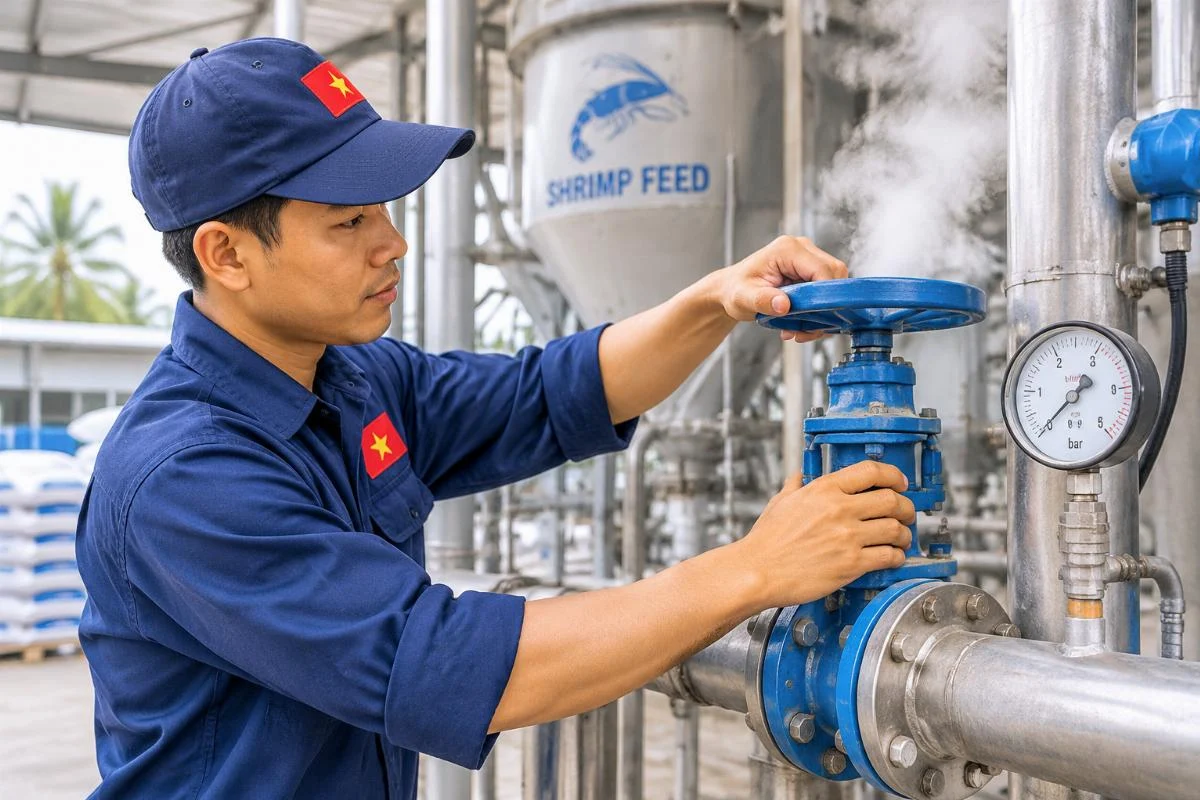
Many suppliers ship the machine, provide a manual, and leave. This approach guarantees early-stage failures. The local operators need to understand how to read the motor amperage to judge the material density inside the barrel. They need to know how to adjust the steam valve based on the smell and texture of the extrudate.
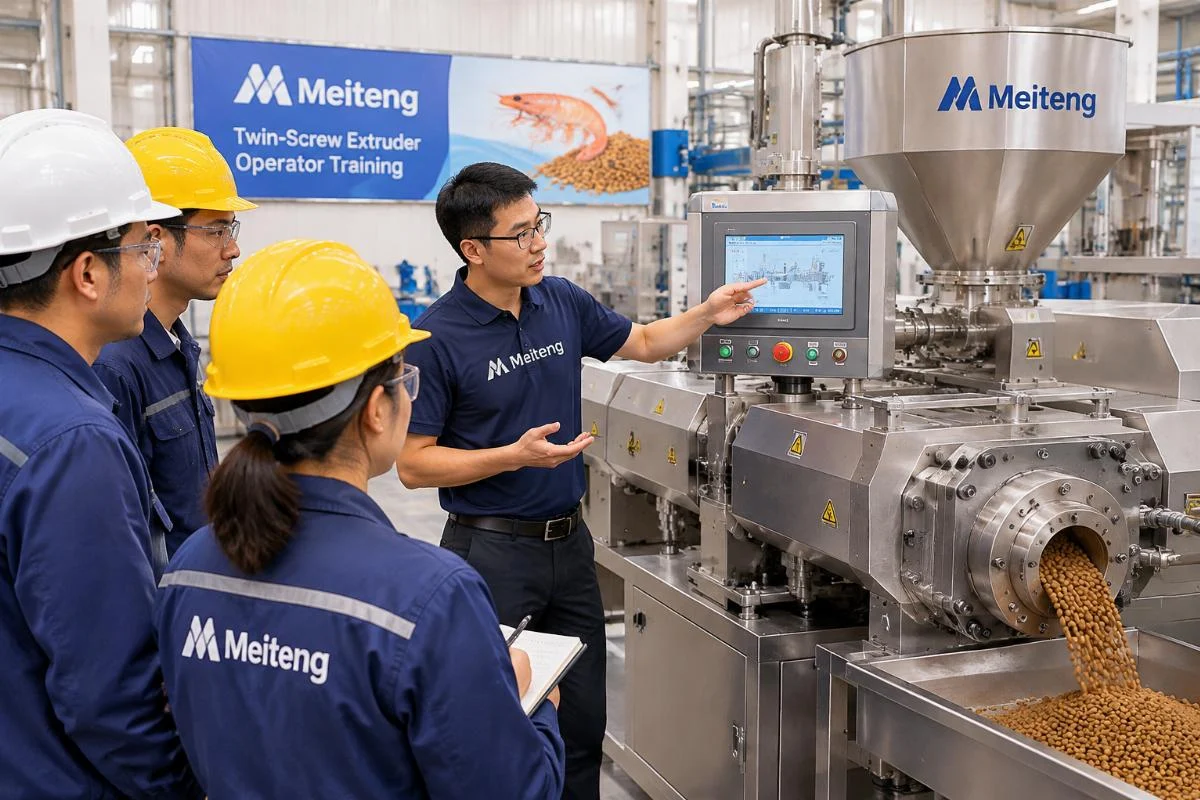
When Meiteng designs a turnkey shrimp feed line, the installation process includes deep-dive operator training tailored to Southeast Asian water conditions. We do not just show them how to press the buttons; we show them how to diagnose a floating pellet by checking the conditioner temperature, or how to fix a cracking pellet by adjusting the dryer airflow.
A shrimp feed producer in Indonesia once struggled with pellet durability. The pellets were sinking, but they were breaking apart in the water before the shrimp could eat them. Our on-site team analyzed the local water salinity and adjusted the binder ratio in the formula, while simultaneously tweaking the cooling system to prevent thermal shock cracks. The pellet durability index improved noticeably, and the feed conversion ratio for the local farmers dropped significantly.
The integration of the entire line—from the raw material intake, through the twin-screw extrusion, to the drying, cooling, and packaging—must be seamless. Every component, from the food-grade stainless steel construction to the automated control panels, must be designed to withstand the harsh, corrosive environment of a coastal feed mill.
Conclusion
Building a successful shrimp feed line in Vietnam or Indonesia requires prioritizing density control and moisture management over theoretical throughput.
Selecting the right twin-screw extruder, sizing the drying system for tropical humidity, and empowering local operators with deep troubleshooting skills are the only ways to ensure consistent sinking rates and pellet durability. Focus on the physical realities of the factory floor, and the commercial success will follow.