Fish Feed Technical Article
Shrimp Feed Extrusion Line for Ecuador: Manufacturer & Turnkey Supplier

Most buyers obsess over the extruder, but the real bottleneck in tropical climates is the dryer.
Successfully importing a shrimp feed line Ecuador requires prioritizing whole-line climate adaptation, especially drying and cooling systems, over standalone extruder specs to prevent mold and ensure pellet water stability.
Early in my career as an aquaculture feed procurement specialist, I learned a brutal lesson the hard way. I sourced a complete setup for a coastal facility in South America, but the supplier only focused on the puffing machine. They completely ignored the local high-temperature and high-humidity environment. The drying and cooling systems were severely underpowered. When the entire container of floating pellets arrived at the port, the whole batch had molded, leading to a total rejection by the client and a mid-six-figure loss. That failure pushed me to transition into equipment manufacturing in Jinan, where I now obsess over the invisible details of whole-line工艺. When configuring a shrimp feed line Ecuador, matching the local climate is the absolute baseline, not an afterthought.

Transitioning from standalone machines to a fully adapted production ecosystem is the only way to secure your investment.
How to Size the Drying System for Ecuador’s Humidity?
Dryer capacity must exceed extruder output by a substantial margin to handle coastal humidity.
When setting up a shrimp feed line Ecuador, the ambient moisture levels near the coast drastically slow down the moisture reduction process. If the drying system is merely matched to the extruder’s nominal output, the pellets will retain too much internal moisture, leading to rapid fungal growth during storage.
A South American client once expanded their facility but kept the original dryer. During the rainy season, the pellets spent too much time in the drying bin, resulting in uneven moisture content and severe clumping. We had to redesign their airflow dynamics and increase the thermal buffer.
To avoid such pitfalls, consider the following risk factors:
- Inadequate thermal recovery in the cooling section.
- Poor air distribution causing localized wet spots.
- Lack of dehumidification integration in the air intake.
At Meiteng, we address this by designing integrated drying and cooling systems that provide a significant capacity buffer, ensuring the moisture content drops to safe levels regardless of the coastal weather.

What Ring Die Specs Ensure Pellet Water Stability?
Compression ratios must be customized for local shrimp feeding habits, not just generic templates.
The water stability of the final product dictates feed waste and water quality in the ponds. For a shrimp feed line Ecuador, using a standard ring die template often results in pellets that disintegrate too quickly in warm water. The compression ratio and the effective thickness of the die must be calculated based on the specific local shrimp species and their biting behavior.
We once worked with a producer who complained about high feed waste. Their pellets looked perfect when dry but turned into mush within minutes in the pond. By adjusting the specific mechanical energy and customizing the die compression ratio for their target species, we achieved a robust gelatinization degree without compromising the expansion rate.
Key considerations for die customization include:
- Material grade suited for abrasive local ingredients.
- Precise hole taper to optimize material flow.
- Alignment with the specific gelatinization requirements of the formula.

How to Validate Formula Adaptability Before Shipping?
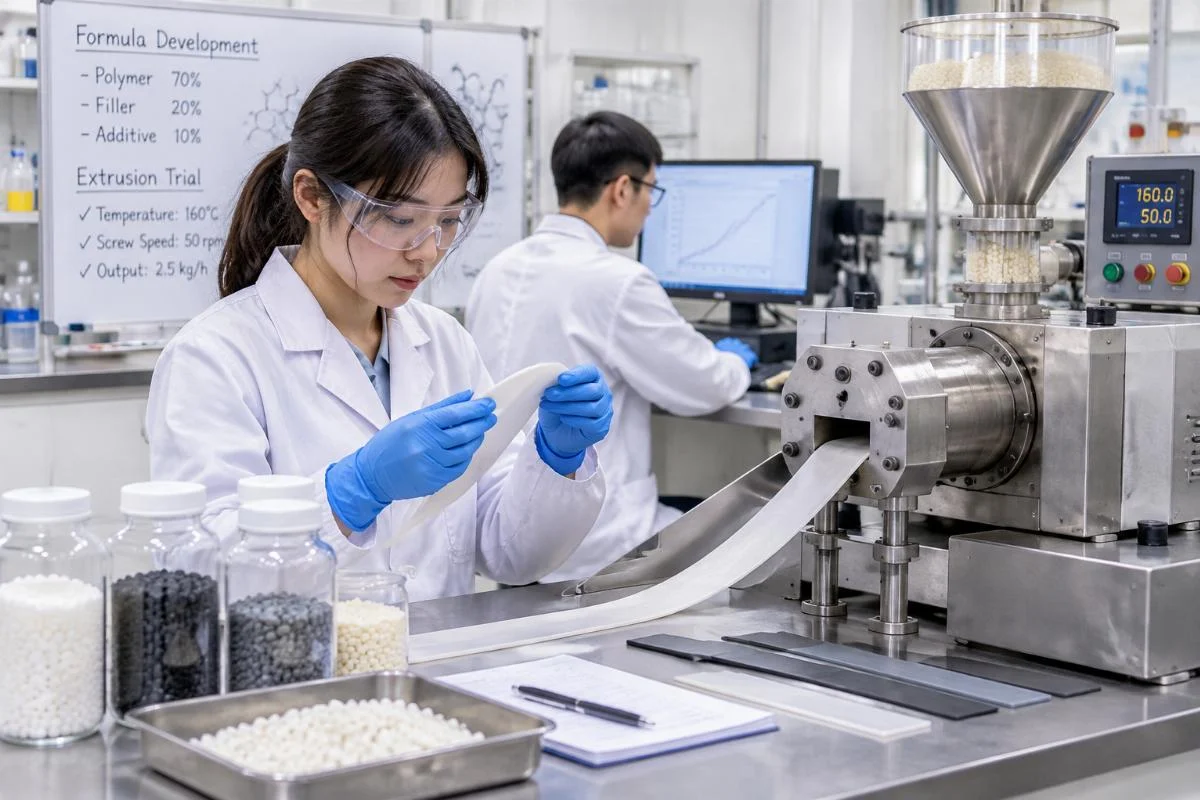
Conduct multiple expansion trials using local raw materials to prevent on-site formulation failures.
Even the best machinery will fail if the formula does not adapt to the extrusion process. Local ingredient substitutions in South America can drastically alter the starch and protein matrix, affecting the puffing behavior. Before finalizing a shrimp feed line Ecuador, it is critical to run extensive trials with the actual raw materials the client intends to use.
A buyer once purchased a line based on standard soy and fishmeal formulas. Upon arrival, they switched to a locally sourced, high-fiber alternative. The pellets failed to float, and the motor overloaded. We had to intervene remotely to adjust the moisture conditioning and screw configuration.
To mitigate this, our approach involves:
- Running initial trials with client-provided samples at our Jinan facility.
- Adjusting the screw profile and barrel temperature zones.
- Conducting final acceptance tests only after the expansion and density meet the target metrics.
What Does a True Turnkey Installation Include?
It covers on-site commissioning, operator training, and remote diagnostics, not just equipment delivery.
Many suppliers claim to offer turnkey solutions, but they merely drop the containers at the port and leave. A genuine turnkey approach for a shrimp feed line Ecuador ensures that the entire system, from raw material intake to packaging, operates seamlessly in the local environment.
When our CE-certified engineers arrive on-site, the focus is not just on bolting machines together. We spend extensive time calibrating the steam conditioning systems to the local water quality and training the operators to recognize the subtle signs of improper gelatinization.
A complete turnkey package must include:
- Detailed layout optimization for workflow and hygiene.
- Rigorous on-site commissioning of all integrated systems.
- Intensive operator training focused on maintenance and troubleshooting.
- Ongoing remote diagnostic assistance to minimize downtime.
Conclusion
Climate adaptation dictates the success of tropical feed production.
Importing a shrimp feed line Ecuador demands a holistic view where drying capacity, die customization, and formula validation take precedence over standalone extruder specs. By prioritizing whole-line integration and rigorous local testing, producers can avoid costly operational failures and ensure consistent, high-quality floating pellets.