Fish Feed Technical Article
Meiteng DS65/DS70 Fish Feed Extruder Manufacturer for Small Mills
Buying a fish feed extruder based solely on the lowest initial price is the fastest way to bankrupt a small aquaculture feed mill.
The core answer to selecting the right equipment is simple: you must match the screw configuration and conditioner parameters to your specific pellet size and formula moisture, prioritizing stable output and pellet density over cheap hardware.
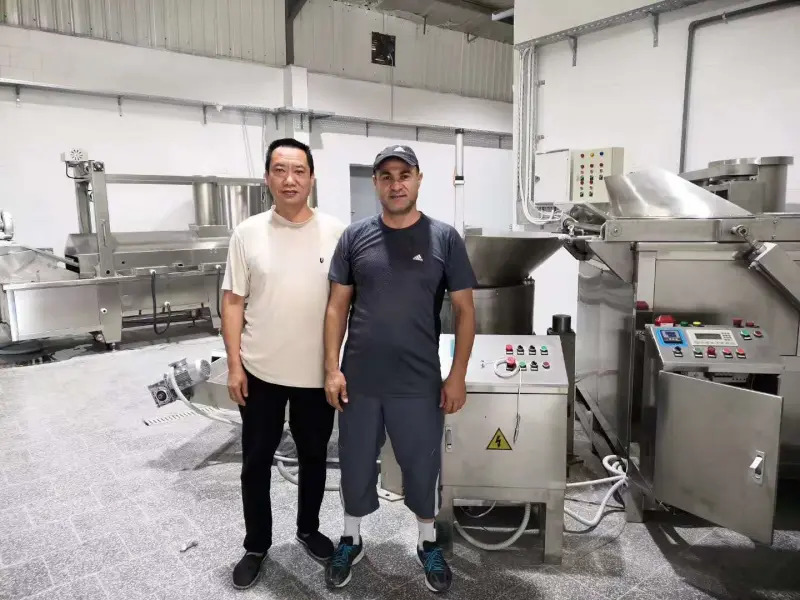
When I was in my early twenties, I spent three sleepless nights in a sweltering, poorly ventilated factory on the outskirts of Lagos, Nigeria. A local client had purchased a twin-screw machine to produce large-pellet sinking tilapia feed, but the output was a disaster. The powder rate was astronomically high, and the pellets disintegrated the moment they hit the water. The issue was not the motor or the steel; it was a complete mismatch between the screw combination, the die, and the conditioner temperature. We had to completely dismantle the barrel, rearrange the screw elements to adjust the specific mechanical energy (SME), and recalibrate the steam saturation in the preconditioner to save the production line. That experience burned itself into my muscle memory. When I transitioned from field service to sales, I realized that for small-scale producers, a comprehensive Fish Feed Extruder Buying Guide is not about finding the cheapest machine; it is about engineering the process to prevent catastrophic downtime.
If you are evaluating equipment for a new startup or expanding your capacity, this Fish Feed Extruder Buying Guide will walk you through the exact technical parameters you need to verify before signing a contract.
How to Match Extruder Specs to Your Feed Formula?
Screw configuration and barrel temperature profiles dictate the final pellet density and water stability, not just the motor horsepower.
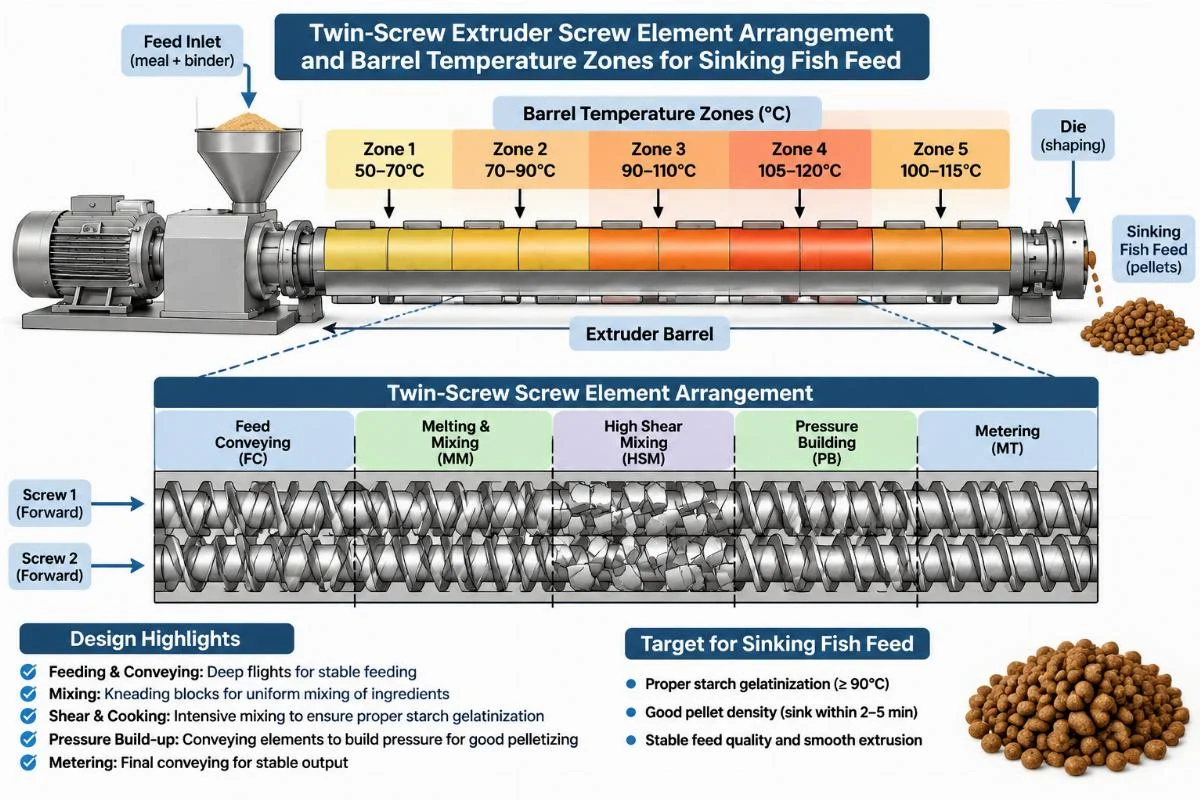
Many buyers mistakenly believe that a bigger extruder is always better. This is a dangerous misconception. Oversized screws in a small feed mill fish feed extruder reduce the shear heat generated inside the barrel. Without sufficient shear heat, the starch gelatinization process fails, completely ruining the density required for sinking pellets. According to extrusion principles, the length-to-diameter (L/D) ratio of the screw directly impacts the residence time and the degree of gelatinization.
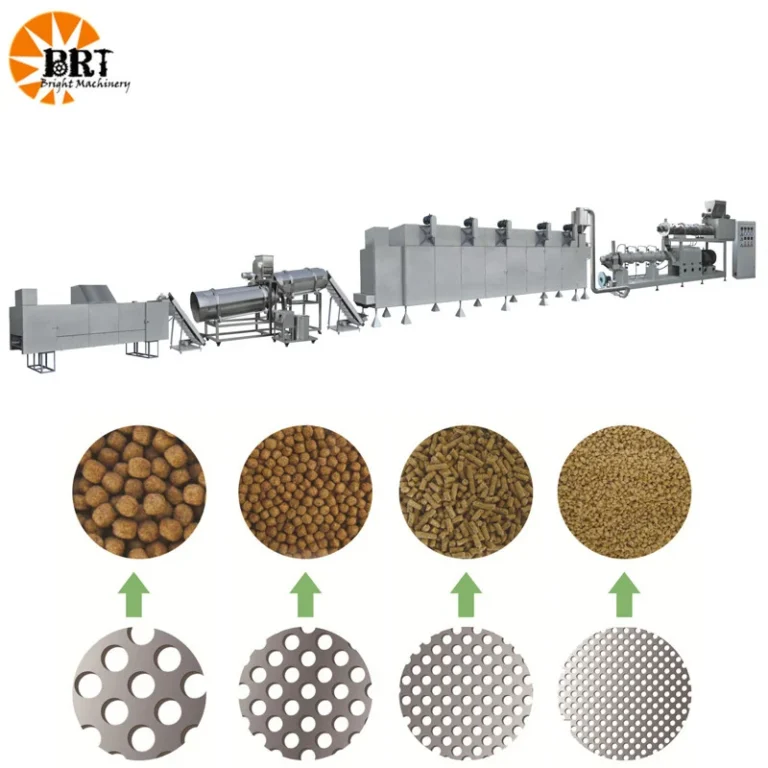
When reviewing any Fish Feed Extruder Buying Guide, you must look at the screw element arrangement. For sinking feed, you need a combination that builds up pressure and generates high shear. For floating feed, the screw design must allow for rapid pressure drop at the die to create the porous structure.
| Parameter | Incorrect Setup (High Powder/Low Density) | Correct Setup (Stable Output) |
|---|---|---|
| Screw L/D Ratio | Too short, insufficient residence time | Optimized for full gelatinization |
| Shear Element Placement | Concentrated at the feed zone | Distributed to build pressure before the die |
| Barrel Temperature | Uniform, lacking thermal gradient | Zoned control for gradual material heating |
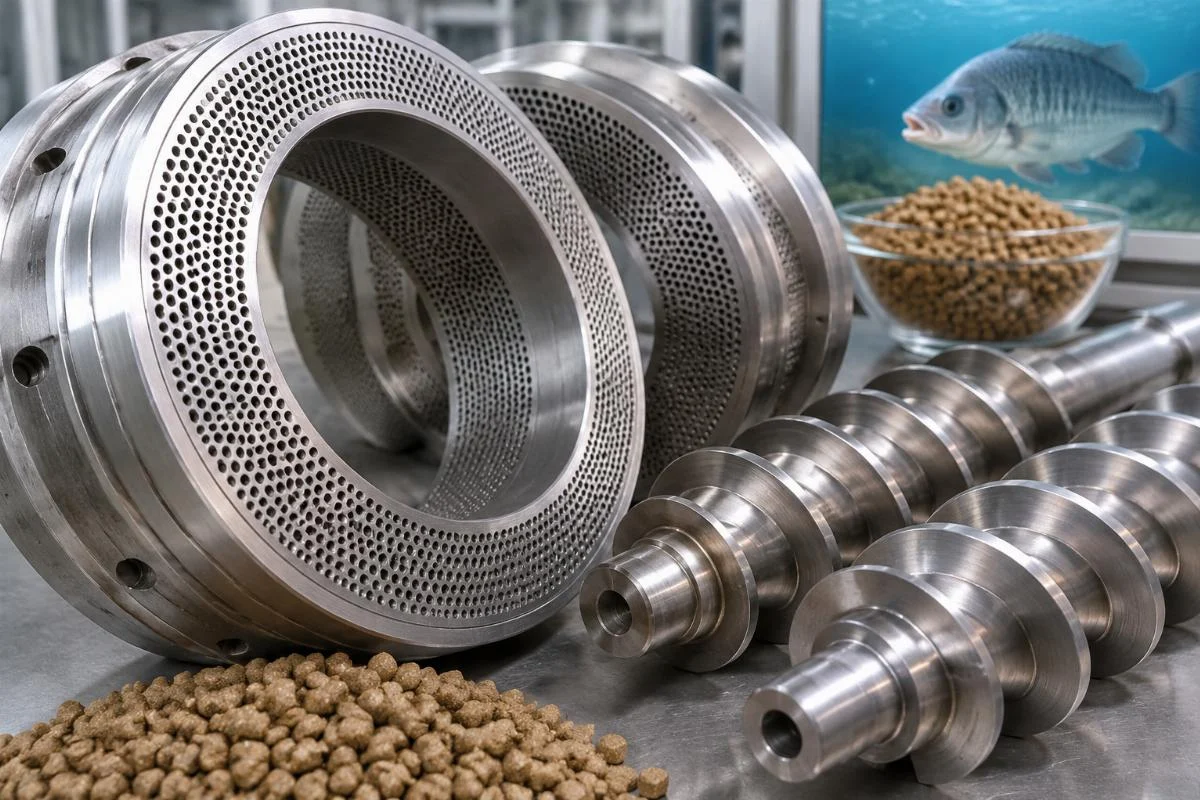
| Die Thickness | Too thin for sinking pellet density | Matched to formula viscosity |
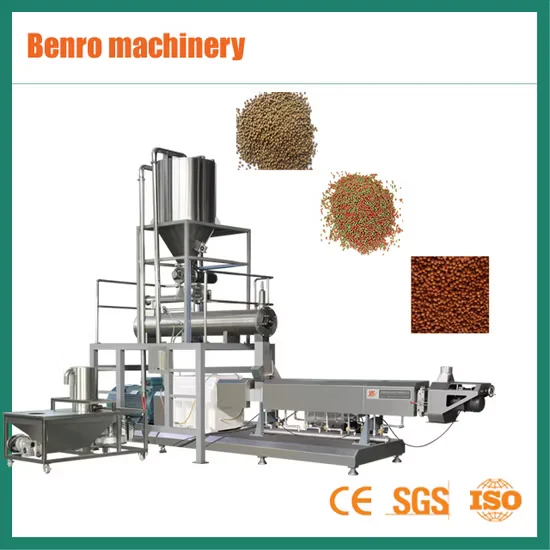
A client in Southeast Asia wanted to produce high-protein shrimp feed. They initially tried to run the formula through a machine configured for low-protein floating carp feed. The result was severe die blockage and massive powder waste. By switching to a customized ring die and adjusting the screw elements to increase the SME range, the pellet forming stabilized completely. The Meiteng DS65 fish feed making machine allows for this exact level of screw customization, ensuring the shear heat matches your specific formula’s rheology.
Why is the Conditioner Critical for Small Mills?
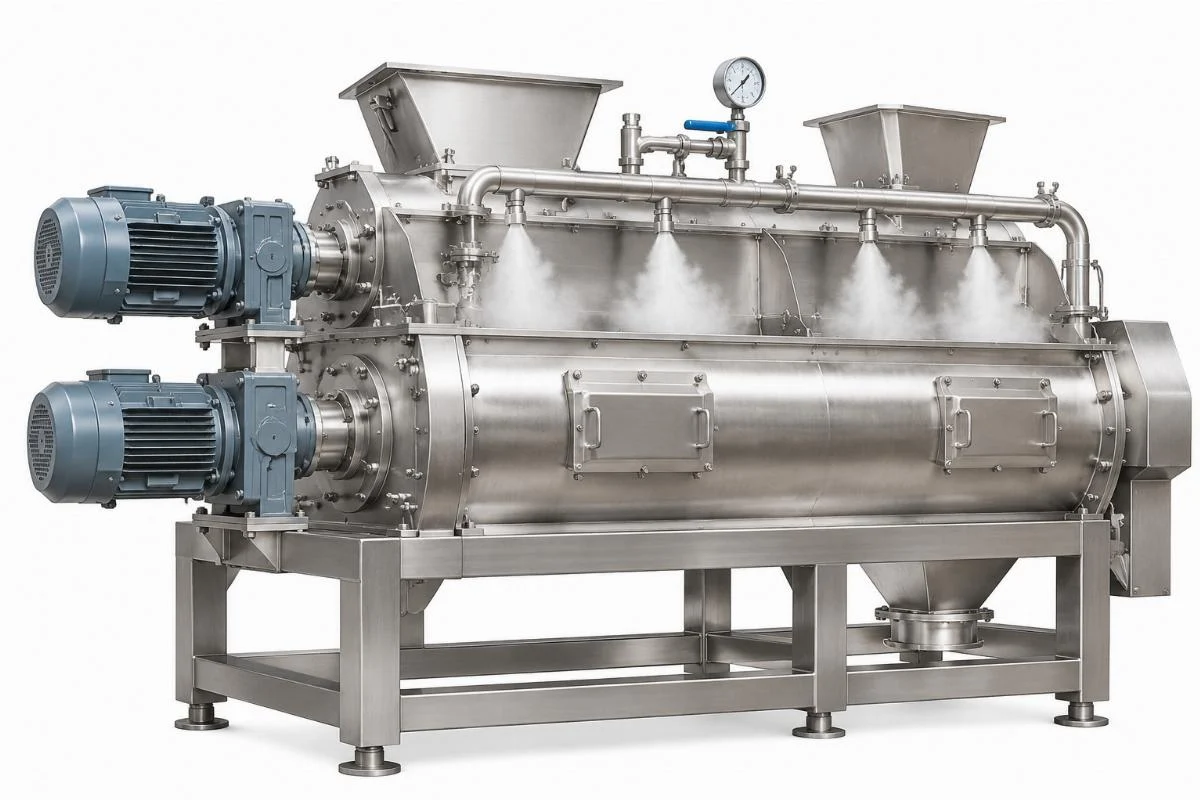
Proper steam conditioning prevents high powder rates and ensures the structural integrity of sinking pellets.
The conditioner is the heart of the pretreatment process, yet it is often the first component buyers try to downgrade to save money. This is a critical error highlighted in any professional Fish Feed Extruder Buying Guide. If the raw materials enter the extruder with uneven moisture or insufficient thermal pre-treatment, the extruder has to do all the work, leading to unstable torque, fluctuating output, and unacceptable powder rates.
Steam saturation metrics in the conditioner are vital. The steam must be dry and saturated to transfer heat efficiently without adding excess free water, which turns the raw material into a paste that clogs the feeder. The retention time in the preconditioner must be long enough to allow the moisture and heat to* material particles.
In a high-moisture raw material scenario, such as using fresh fish offal or high-moisture cassava, the preconditioning retention time must be extended. If the material moves too quickly, the surface gelatinizes while the core remains dry, causing the pellet to explode or crack during the drying phase.
When evaluating the twin screw fish feed extruder price, do not just look at the extruder barrel. Look at the conditioner’s shaft speed, paddle angle, and steam injection nozzles. A well-designed conditioner ensures that the material enters the extruder at a uniform temperature and moisture level, which is the only way to achieve a stable extrusion process and minimize the powder rate that eats into your profit margins.
How to Size the Complete Turnkey Line?
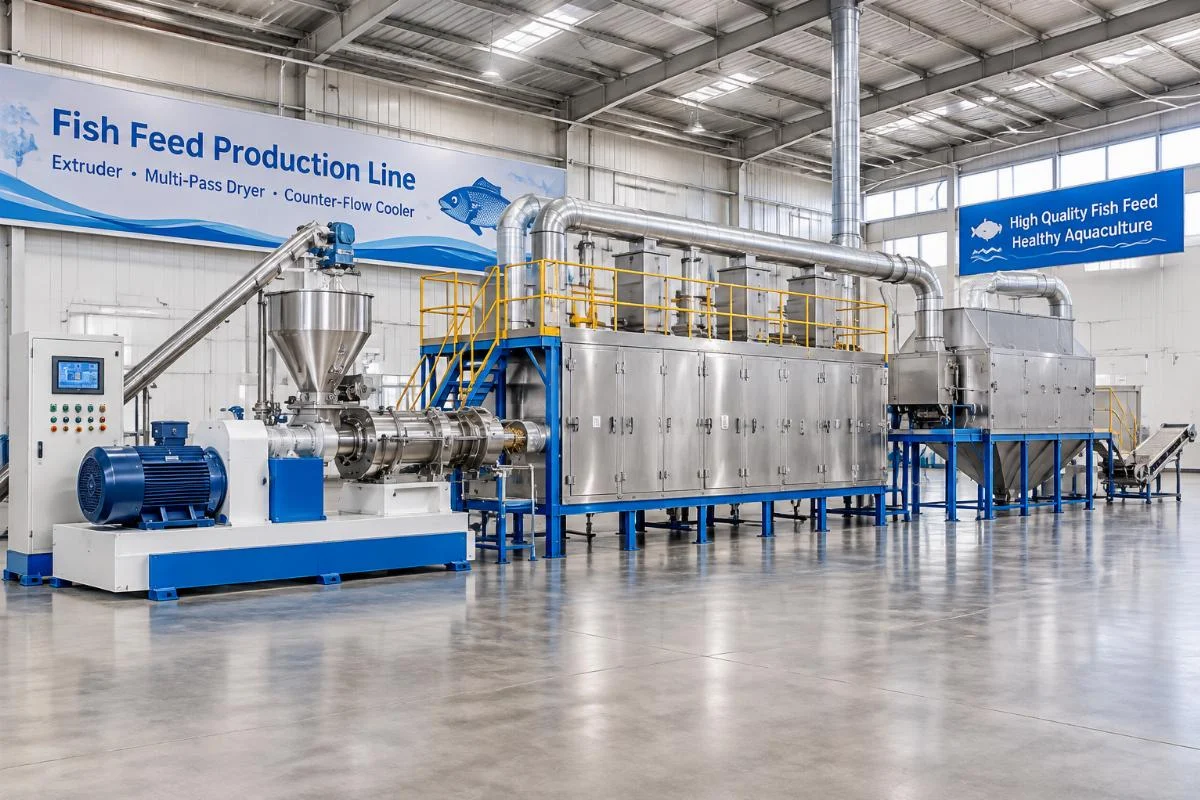
Extruder capacity must perfectly sync with the dryer and cooler to avoid severe production bottlenecks.
A common trap for small mill owners is focusing entirely on the extruder’s output rating while ignoring the downstream equipment. A Fish Feed Extruder Buying Guide must emphasize that the extruder is only one part of a continuous thermodynamic process. The freshly extruded pellets contain high moisture and must be dried to a safe storage level quickly. If the dryer is undersized, the pellets will sit in a queue, leading to mold growth or structural collapse.
Consider the capacity scaling scenario. If you are running a DS65 fish feed making machine at its optimal throughput, the drying and cooling system must be sized to handle that exact continuous flow. The drying process is not just about removing water; it is about removing water at a controlled rate to prevent case hardening, where the outside of the pellet dries too fast and traps moisture inside.
| Line Component | Undersized Consequence | Properly Sized Solution |
|---|---|---|
| Dryer | Pellet mold, structural collapse, bottleneck | Multi-pass drying with controlled humidity |
| Cooler | Condensation in packaging, reduced shelf life | Counter-flow cooling to ambient temperature |
| Coating System | Uneven fat distribution, poor palatability | Precision vacuum coating for uniform absorption |
Meiteng provides full turnkey line design from raw material intake to packaging. This means the dryer length, mesh belt speed, and cooler airflow are all calculated based on the specific output of your DS65 or DS70 extruder. This holistic approach ensures that your initial investment in the extruder is not wasted due to a bottleneck in the drying section.
What After-Sales Support Minimizes Downtime?
On-site commissioning and operator training are non-negotiable for startup mills to ensure long-term profitability.
Even the most perfectly engineered machine will fail if the operators do not understand the thermodynamics of extrusion. The transition from a theoretical formula to a stable production run requires human intuition and technical adjustment. This is where the supplier’s after-sales support becomes the most critical factor in your Fish Feed Extruder Buying Guide checklist.
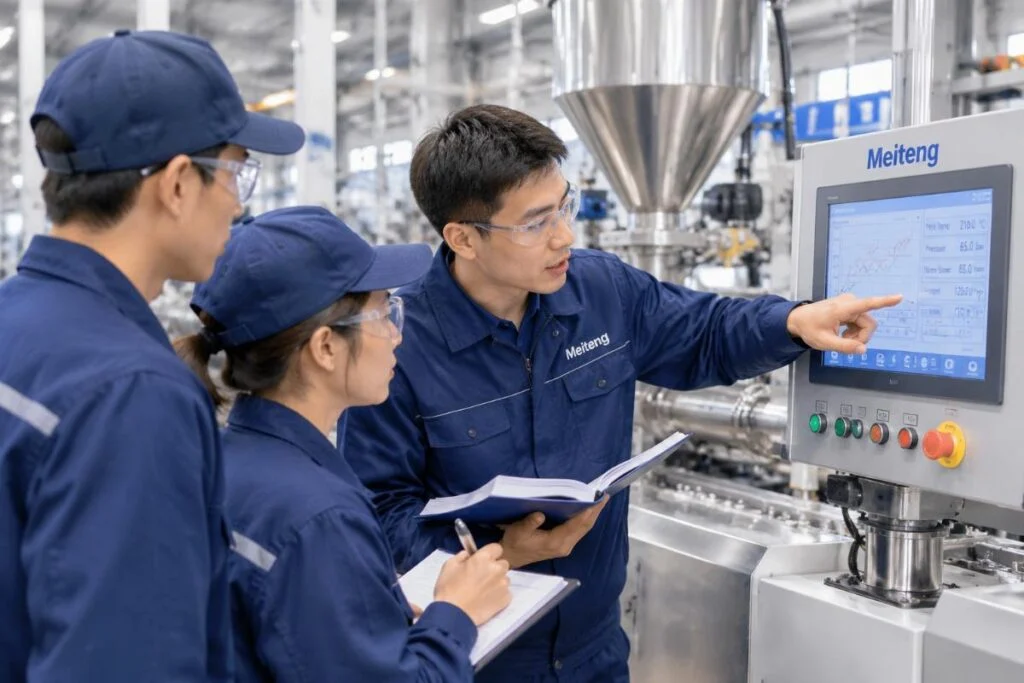
Startup mills cannot afford extended downtime. Every hour the line is stopped for troubleshooting is a direct loss of revenue and market share. The manufacturer must provide on-site installation, commissioning, and comprehensive operator training. The technicians need to teach your staff not just how to push buttons, but how to read the amperage meter, how to adjust the steam valve based on the sound of the motor, and how to change the die safely.
Furthermore, formula development support is crucial. Small producers often lack the R&D resources to perfect their recipes. A reliable partner will assist with recipe formulation, helping you balance the protein, lipid, and starch sources to ensure they extrude properly under the specific SME conditions of your machine.
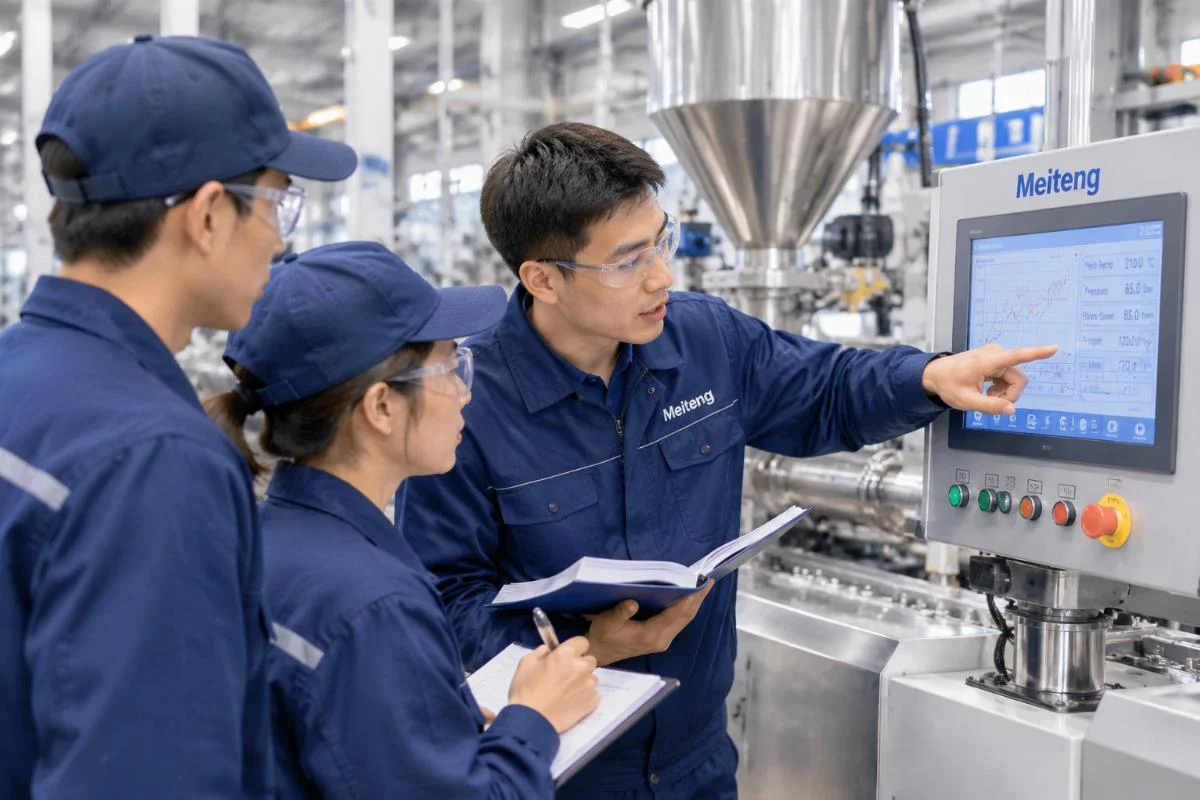
When I reflect on those long nights in Lagos, I realize that the machine was only half the solution. The real solution was having a technical partner who understood how to tweak the variables until the process clicked. Meiteng’s commitment to on-site commissioning and multi-language technical support ensures that your team is never left guessing when production parameters shift.
Conclusion
Selecting the right equipment is an exercise in process engineering, not just price comparison.
A successful small feed mill relies on the precise synchronization of screw configuration, conditioner steam saturation, and downstream drying capacity. By prioritizing technical matching and comprehensive turnkey support over the lowest initial twin screw fish feed extruder price, producers can eliminate high powder rates, ensure pellet density, and build a stable, profitable operation.