Fish Feed Technical Article
Fish Feed Extruder for Indonesia & Philippines | Meiteng Manufacturer

Most buyers assume pellet sinking is a die issue; the real culprit is often local raw material moisture or inadequate cooling in tropical heat.
When shipping fish feed extruder to Indonesia and Philippines, success demands more than just logistics. It requires deep equipment adaptation to local high-moisture starches and extreme ambient temperatures to guarantee floating feed quality and gelatinization.
I still remember the sweltering heat of a factory in the Middle East, standing by a floating fish feed line while the client pointed angrily at a pool of sunken pellets. I had just arrived from the assembly车间 back home, where I used to inspect quality control, and I stubbornly believed the screw parameters on the blueprint were flawless. It took three days of squatting in that humid,闷热的厂房 to realize the truth. The local cassava flour had a much higher moisture content than our standard tests, and the cooling system was completely undersized for the desert heat, resulting in insufficient gelatinization. That moment彻底 changed my perspective on exporting machinery. Selling equipment is never just about shipping a box of steel; it is about understanding the local water, the climate, and the脾气 of regional raw materials. When you are shipping fish feed extruder to Indonesia and Philippines, these hidden variables dictate whether your investment floats or sinks.

If you are navigating the complexities of export fish feed making machine Southeast Asia, you need to look beyond the port of arrival. Let us break down the real operational hurdles.
What are the key packaging and shipping requirements for tropical climates?
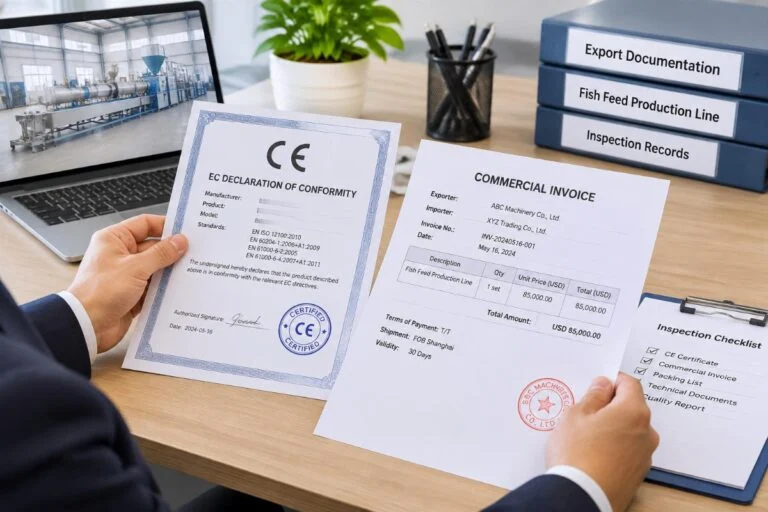
Standard export packaging is rarely enough for the high-humidity ports of Southeast Asia; electrical components and precision parts require enhanced moisture-proofing to prevent corrosion before installation even begins.
When organizing a twin-screw extruder shipping to Indonesia, the maritime journey through the equator is brutal. Salt-laden air and extreme humidity can wreak havoc on sensitive electrical cabinets and barrel heaters if they are not properly sealed. We have seen cases where standard vacuum packaging failed, leaving control panels corroded by the time the container reached Java.
To mitigate this, every electrical component must be wrapped in multi-layer anti-rust film with industrial-grade desiccants placed directly inside the control cabinets. The main motor and gearbox require sealed wooden crates with internal vapor barriers.
Furthermore, port-to-site logistics in this region present unique challenges. I recall a project where we had to disassemble a container load of dryers and navigate incredibly narrow rural roads in Java for on-site assembly. The local infrastructure often cannot accommodate standard 40-foot high-cube containers fully loaded with assembled lines. Therefore, modular disassembly and precise container consolidation are mandatory. You must plan for the final mile, ensuring that every flange, bolt, and sensor is tagged and packed in a way that allows local teams to reassemble the line without losing critical parts to rust or humidity.

How do local raw materials like cassava affect extruder configuration?
Local starches like cassava flour possess significantly higher moisture retention and different gelatinization thresholds compared to standard corn or wheat, requiring specific screw configuration tweaks and barrel heating adjustments.
In Indonesia, cassava is a dominant, cost-effective raw material for aquaculture feed. However, its high moisture content changes the fluid dynamics inside the extruder barrel. If you simply use a standard configuration designed for dry corn, the material will slip, failing to build the necessary pressure and shear force for proper expansion.
During my time troubleshooting in the field, I learned that the screw L/D ratio and the arrangement of compression zones must be adjusted. For high-moisture cassava, we need to increase the shear sections to generate enough frictional heat to drive off excess water and achieve the required gelatinization degree.. The barrel heating zones also need precise independent control; relying on friction alone will lead to uneven cooking and unstable pellet density.
This is where Meiteng’s turnkey solutions prove their worth. Instead of sending a generic machine, our engineering team analyzes the specific moisture content and fiber profile of your local cassava supply. We then custom-design the screw elements and barrel heating profiles to ensure that the starch fully gelatinizes, creating the protein-starch matrix necessary for the pellet to trap air and float.

Why do floating feed pellets sink during initial trials in Southeast Asia?
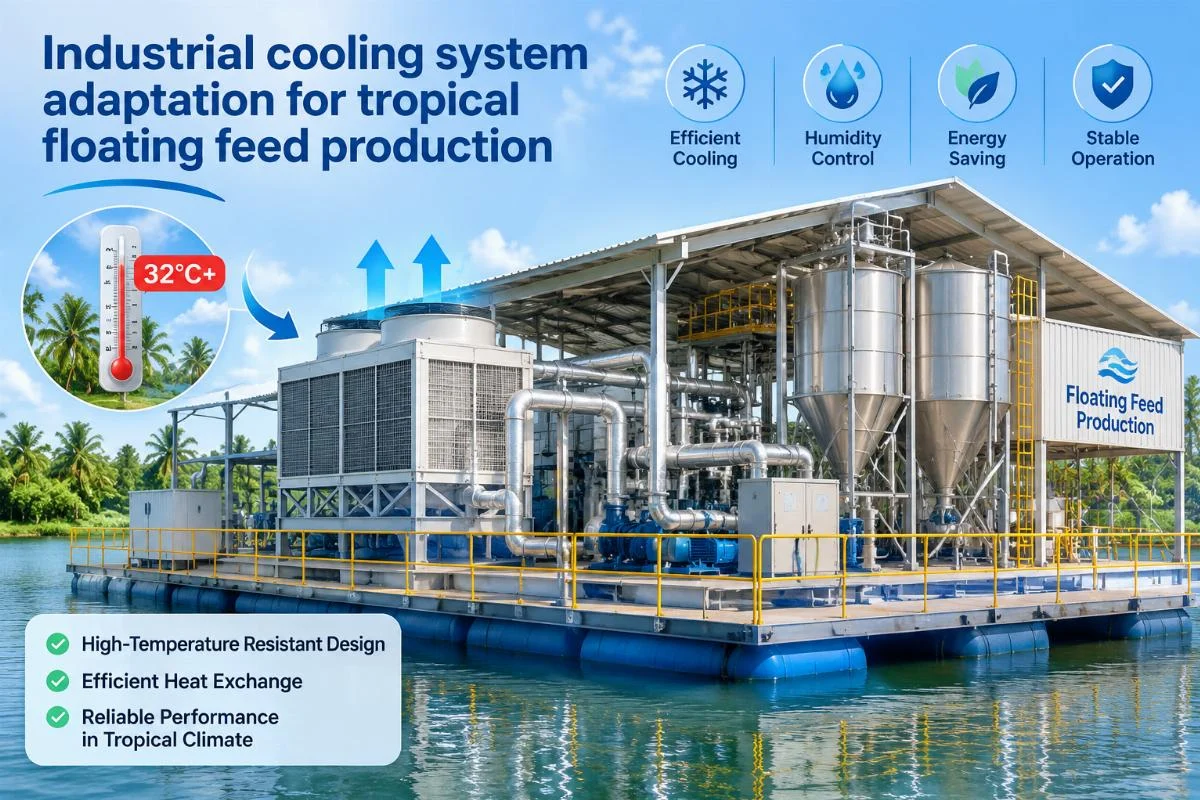
Pellet sinking in tropical environments is frequently a thermal management failure; the cooling system must be massively oversized to counteract high ambient temperatures and maintain the structural integrity of the expanding matrix.
When the extruded pellets exit the die, they are full of steam and expanding rapidly. To lock in the air cells that make them float, they must be cooled and dried quickly. In temperate climates, a standard counter-flow cooler works perfectly. But in the Philippines or Indonesia, where ambient temperatures and humidity levels are consistently high, the cooling air is already saturated with moisture and heat.
If the cooling system is undersized, the pellets remain in a semi-plastic state for too long. The air cells collapse, moisture re-enters the porous structure, and the pellets sink. This is exactly what happened to my client in the Middle East, and it is a common trap for aquaculture feed machinery delivery Philippines projects. The solution is not to blame the die maker; it is to upgrade the heat dissipation capacity of the entire drying and cooling circuit.
Meiteng integrates drying and cooling systems specifically calculated for tropical heat dissipation.. We increase the airflow volume, enhance the dehumidification stages, and extend the cooling retention time to ensure that the gelatinization degree is locked in, guaranteeing a stable floating rate even when the factory temperature hits the mid-thirties.
What installation and training support is provided on-site?
Overcoming rural infrastructure challenges and training operators on local recipes is just as critical as the mechanical assembly; success relies on transferring practical knowledge of local raw material behavior.
Getting the machinery to the site is only half the battle. Once the twin-screw extruder shipping to Indonesia arrives, the real work begins. Local operators often have deep knowledge of traditional feed mixing but may lack experience with the precise moisture control required for high-shear extrusion.
On-site installation must account for local power fluctuations, water quality, and spatial constraints. Our technicians do not just bolt the machines down; they spend weeks on the floor, working side-by-side with local staff. We conduct gelatinization degree testing and adjust the water injection systems in real-time based on the day’s batch of cassava or rice bran.
Training goes far beyond pressing buttons. It involves teaching the team how to “read” the motor amperage and the steam pressure to anticipate how the local raw materials will behave that specific day. By providing multi-language technical support and remote diagnostic assistance, Meiteng ensures that your team can troubleshoot minor recipe adjustments independently, minimizing downtime and ensuring consistent feed quality.

Conclusion
Shipping a machine is easy; engineering it to survive the local climate and raw materials is what builds a profitable aquaculture feed business.
Navigating the logistics of shipping fish feed extruder to Indonesia and Philippines requires a partner who understands that tropical heat and high-moisture crops demand custom screw designs, oversized cooling systems, and enhanced moisture-proof packaging. True success comes from adapting the technology to the local environment, ensuring every pellet floats and every operation thrives.