Fish Feed Technical Article
Do You Need an Import License for Fish Feed Machinery?
Most buyers assume aquaculture extruders ship like standard farm tools, but the reality is that they frequently trigger strict agricultural and mechanical import controls.
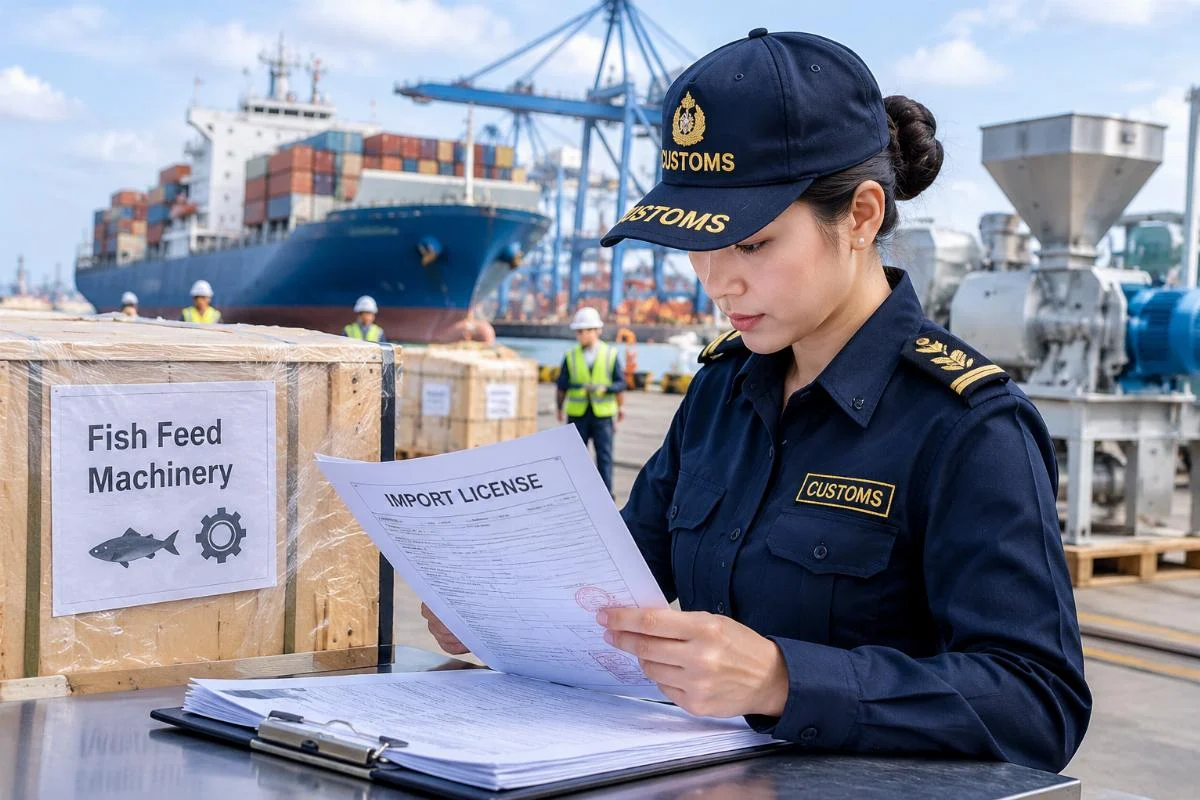
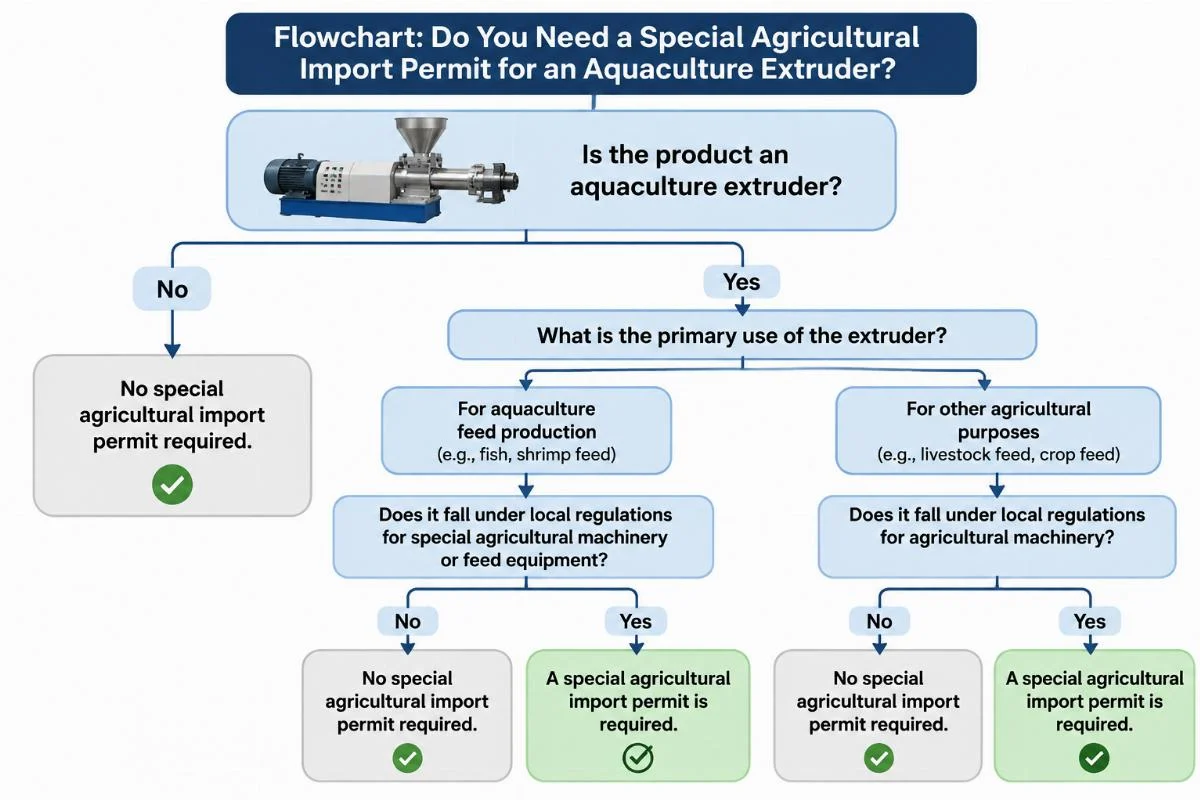
Yes, you almost certainly need a specific import license for fish feed machinery. In many jurisdictions, twin-screw extruders and complete production lines fall under specialized agricultural or electromechanical import categories, requiring explicit permits from local ministries of agriculture or industry before the equipment can clear customs.
I learned this the hard way years ago when I was sourcing processing lines for a European feed startup. At a Chicago trade show, our client purchased a twin-screw fish feed extruder from us, operating under the assumption that it would clear customs just like standard agricultural implements. They completely overlooked the fact that their destination country required a specific import license for aquaculture machinery. The container got stuck at the port for weeks, racking up massive demurrage fees while they scrambled to retroactively apply for permits. That headache fundamentally shifted how I approach international equipment sales. Now, whenever buyers inquire about our extrusion lines, I do not just discuss throughput capacity; I immediately dig into their local import regulations to verify if they need a specialized import license for fish feed machinery before we even draft a contract.
Navigating these regulatory frameworks can be the difference between a smooth startup and a financial disaster, which brings us to the specific documentation and procedures required to keep your cargo moving.
Is a Special Import License Required for Fish Feed Machinery?
Yes, specialized permits are mandatory in most regions because aquaculture extruders are classified under strict agricultural or electromechanical import control lists, rather than general machinery.
When you import standard tractors or basic conveyors, the customs process is relatively straightforward. However, fish feed production lines involve complex thermal and mechanical processing, which many governments categorize under sensitive agricultural technology or specialized electromechanical equipment. This means standard freight documents are insufficient. You must verify if your specific HS code triggers the need for an import license for fish feed machinery from your local ministry of agriculture or commerce.
I once worked with a Southeast Asian aquaculture feed producer who wanted to upgrade their floating fish feed line. They assumed the equipment would clear customs under a general “industrial machinery” code. We intercepted this assumption during the pre-shipment phase. By cross-referencing their national agricultural ministry permit lists, we identified that their specific twin-screw extruder import permit required a separate agricultural technology endorsement. We adjusted the commercial invoice and technical descriptions to align perfectly with the permitted HS code, ensuring full compliance.
If you fail to secure the correct import license for fish feed machinery, the risks are severe:
- Complete rejection of the cargo at the port of entry.
- Mandatory re-exportation at the buyer’s expense.
- Heavy administrative fines for attempting to clear restricted goods without authorization.
- Blacklisting of the importing entity for future customs transactions.
Which Documents Are Mandatory for Customs Clearance?
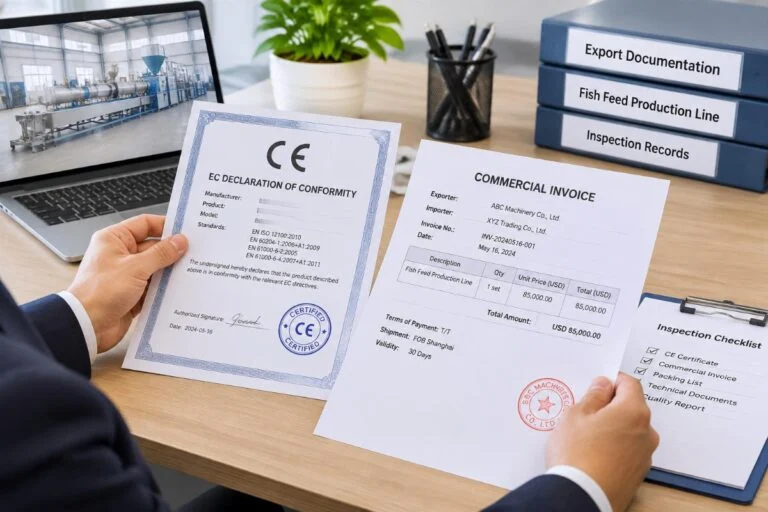
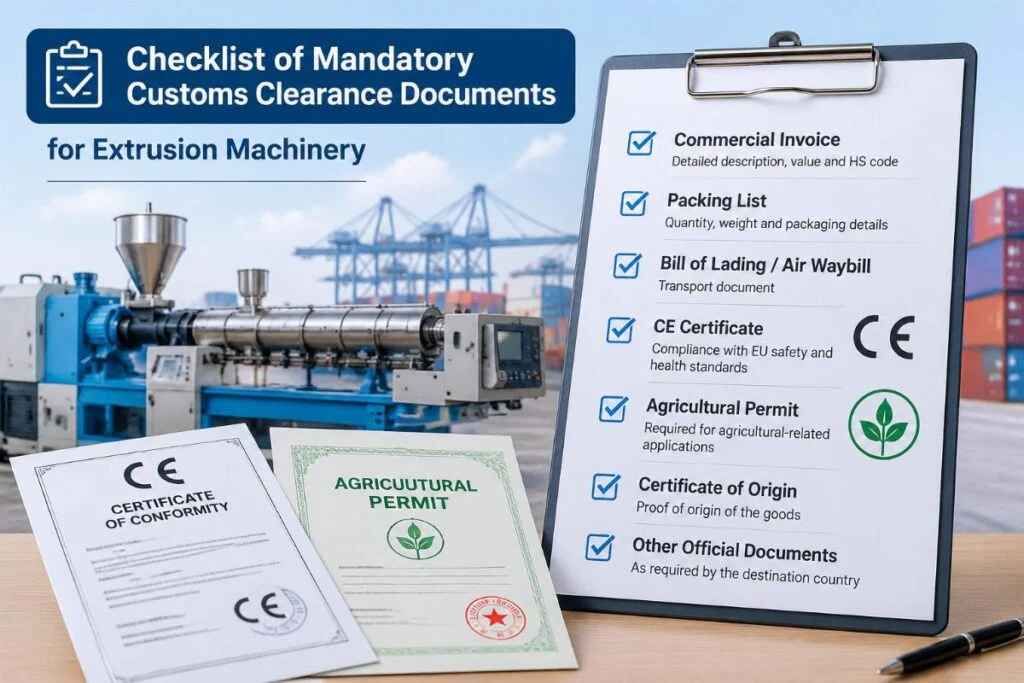
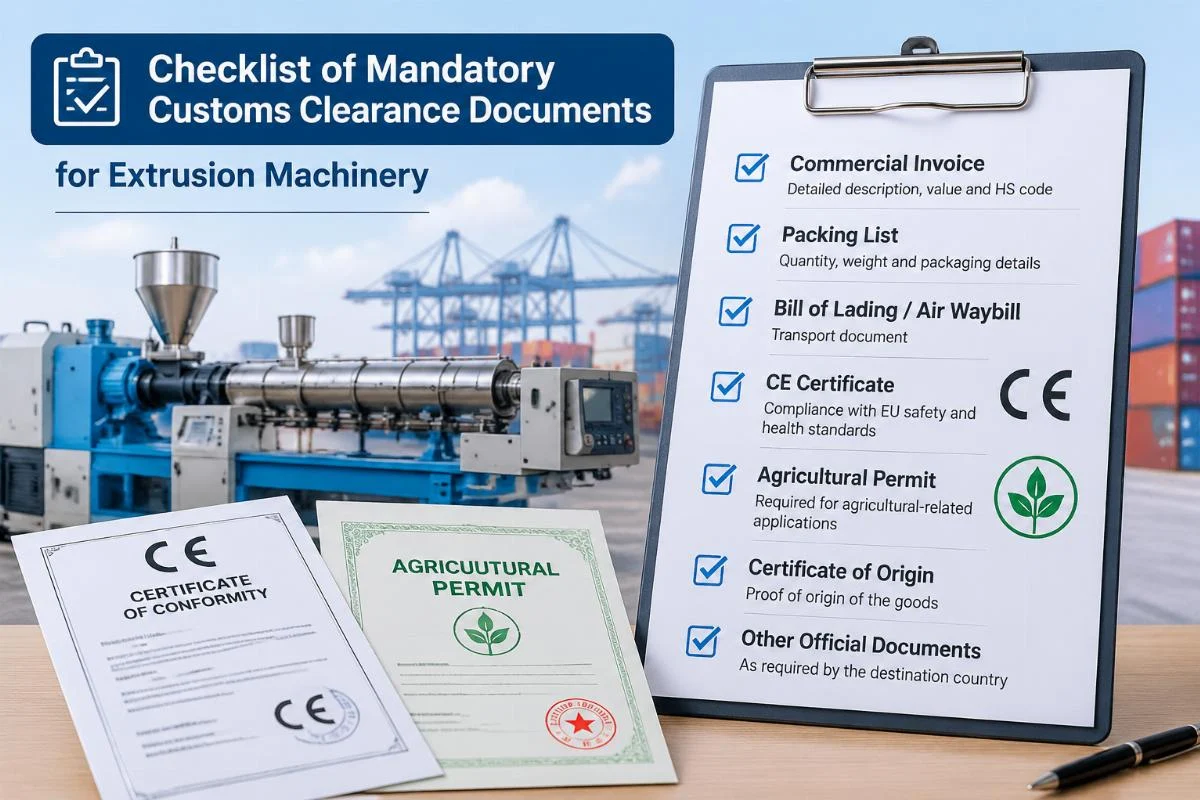
Beyond the commercial invoice and packing list, you must provide CE or ISO certificates, specific agricultural ministry permits, and accurate HS code declarations to satisfy customs authorities.
Securing the import license for fish feed machinery is only the first step; the actual customs clearance process demands a flawless dossier of supporting documents. Customs officials are trained to look for discrepancies between the declared machinery and the provided safety or agricultural certifications. If your documentation package is incomplete, the cargo will be held in a bonded warehouse.
For a typical twin-screw extruder import permit application, the following documents are non-negotiable:
- Commercial Invoice & Packing List: Must explicitly state the machine’s intended use (e.g., “aquaculture feed extrusion”) and match the HS code on the permit.
- CE / ISO 9001 Certificates: Proof that the manufacturing facility and the equipment meet international quality and safety standards.
- Certificate of Origin: Required to claim any preferential tariff rates under bilateral trade agreements.
- Technical Drawings & Operation Manuals: Often requested by agricultural ministries to verify the machine’s function and ensure it does not violate local environmental or biosecurity regulations.
- The Import License Itself: The physical or digital permit issued by the destination country’s relevant authority.
A Latin American startup once approached us to source a complete pet food and fish feed production line. They had the funds ready but lacked the technical documentation required by their local customs. Because Meiteng provides comprehensive turnkey services, our team proactively compiled all necessary CE and ISO export documentation, along with detailed technical manuals, before the contract was even signed. This preparation allowed them to present a complete file to their agricultural ministry, drastically smoothing the approval process for their import license for fish feed machinery.
Failure to prepare these documents leads to:
- Endless back-and-forth with customs brokers.
- Requests for supplementary inspections by port authorities.
- Degradation of sensitive electrical components while sitting in humid port storage.
How to Avoid Port Demurrage and Delays?
Pre-shipment verification of local aquaculture extruder import regulations and precise HS code alignment is the only reliable method to prevent costly container滞留.
The most critical phase of importing an import license for fish feed machinery happens long before the machine is loaded into a shipping container. It happens during the initial procurement and compliance review. Many buyers focus entirely on the FOB price and machine specifications, ignoring the regulatory landscape of their own country. This oversight is a primary driver of port demurrage.
To avoid these delays, you must integrate regulatory compliance into your procurement timeline. Here is the standard procedure we enforce with our clients:
- Initial HS Code Consultation: Before finalizing the machine configuration, the buyer’s local customs broker must confirm the exact HS code for the specific extruder model.
- Permit Application: The buyer applies for the necessary agricultural or mechanical import permits using the confirmed HS code and preliminary technical data.
- Document Alignment: Once the permit is granted, the manufacturer adjusts the final commercial documents to match the permit’s exact wording and codes.
- Pre-Shipment Inspection: Some countries require a pre-shipment inspection (like SGS or BV) to verify the machine’s condition and compliance before loading.
During my time sourcing for a European startup, we nearly fell into the trap of rushing a shipment. We had a twin-screw extruder ready to ship, but I insisted on waiting two extra weeks until the buyer’s local agricultural permit was officially stamped. That patience saved the project. Conversely, I have seen deals stall at the port simply because someone forgot to check the paperwork, resulting in an import license for fish feed machinery being applied for while the container was already accruing daily storage fees.
Risks of skipping pre-shipment verification:
- Misalignment between the Bill of Lading and the Import License.
- Inability to clear the goods until the original shipper amends documents from overseas.
- Loss of warranty validity if the machine is damaged during prolonged port storage.

What Are the Hidden Costs of Non-Compliance?
Demurrage fees, storage penalties, and administrative fines associated with an unapproved import license for fish feed machinery can quickly outweigh the initial machinery investment.
When budgeting for a new aquaculture feed production line, buyers typically calculate the cost of the equipment, the shipping freight, and the import duties. What they rarely budget for is the catastrophic financial impact of non-compliance. The hidden costs of failing to secure the correct import license for fish feed machinery are not just minor inconveniences; they are budget-destroying events.
Port demurrage is the most immediate and aggressive of these costs. Shipping lines and terminal operators charge daily fees for containers that are not cleared and removed from the port within the allotted free time. These fees escalate exponentially after the first few days. If a twin-screw extruder import permit is delayed, a single container can generate storage costs that rival the price of the machine itself.
Furthermore, non-compliance can lead to:
- Forced Repackaging or Re-export: If the customs authority determines the machine cannot be imported under the current license, you must pay to ship it back to China or to a third country, doubling your freight costs.
- Equipment Degradation: Extruders contain sensitive electrical panels, motors, and precision screws. Sitting in a coastal port environment without proper climate control can cause corrosion and electrical faults, leading to expensive repairs before production even begins.
- Project Delays: A delayed machine means delayed feed production, which can cause you to miss critical seasonal aquaculture cycles, resulting in lost revenue that far exceeds the cost of the equipment.
A Middle East aquaculture feed producer once shared a cautionary tale with me. They purchased a processing line from a competitor who simply handed over the standard freight documents without verifying local agricultural import regulations. The container sat at the port for weeks. By the time they sorted out the import license for fish feed machinery, the demurrage fees and the cost of repairing salt-damaged electrical components had added a massive, unbudgeted premium to the project. That is why Meiteng’s turnkey service includes proactive regulatory checks; we ensure our clients have the complete CE/ISO export documentation and regulatory guidance before signing, effectively eliminating these hidden risks.

Conclusion
Securing the correct import license for fish feed machinery is a non-negotiable prerequisite that dictates the financial viability of your aquaculture project.
Always verify your local agricultural and electromechanical import regulations before signing any purchase contract. By aligning your HS codes, preparing comprehensive CE and ISO documentation, and understanding the true cost of port delays, you protect your investment and ensure your production line starts operating on schedule.