Fish Feed Technical Article
Fish Feed Extruder Particle Size Control: DS70 Twin-Screw Manufacturer

The die hole diameter does not determine your final pellet size; internal shear force and moisture distribution do.
Raw material particle size fish feed directly dictates the degree of starch gelatinization, mechanical shear force, and the ultimate expansion ratio of the extruded pellets. Precise control requires matching the raw material particle size fish feed with barrel temperature profiles and specific screw configurations to ensure uniform pellet sizing and minimize powder rates.
Years ago, I was commissioning a DS70 twin-screw extruder in Xiangshan, Ningbo. The floating fish feed coming off the line was a mess—pellet sizes were wildly inconsistent, and the powder rate was unacceptably high. The client was on the verge of rejecting the entire batch. I spent two days in the workshop tracing the issue before finding the real culprits: a drifting temperature sensor in the third barrel zone and a screw shear section that was completely mismatched for their high-starch formula. The insufficient gelatinization caused the cut pellets to expand irregularly. Since then, whether I am on-site or designing a production layout, my first step is always verifying the temperature curves and screw combinations. Controlling raw material particle size fish feed is never just about looking at the die plate; moisture, temperature, and shear force must be perfectly synchronized.

Let us break down the step-by-step methodology to master this process.
How Does Particle Size Affect Fish Feed Expansion?
Raw material particle size fish feed determines the surface area available for heat and moisture transfer, directly influencing starch gelatinization and the subsequent expansion ratio.
When raw materials enter the extruder, the particle size dictates how quickly and uniformly the starch granules absorb water and rupture under heat and shear.
If the particles are too coarse, the center of the particle may remain ungelatinized. This lack of structural matrix prevents proper gas retention during the pressure drop at the die, resulting in dense, poorly expanded, or sinking pellets when floating feed is intended. Conversely, a common misconception is that finer is always better. Overly fine particles create excessive friction, leading to localized overheating. This thermal degradation destroys heat-sensitive nutrients and causes the material to scorch, creating weak pellet structures that shatter into fines after cooling.
The ideal raw material particle size fish feed ensures a uniform melt viscosity. This uniformity allows the mechanical energy from the screws to be converted efficiently into expansion energy rather than wasted as erratic friction.

What Are the Common Particle Size Mistakes in Extrusion?
Overlooking the balance between moisture content, screw shear, and particle size distribution leads to irregular pellet sizing and high fines generation.
Many producers focus solely on the grinder screen size, ignoring how the milled material interacts with the extruder’s internal mechanics. Here are the critical mistakes:
- Ignoring Moisture Balance: Particle size alters the required preconditioning moisture. Finer particles require less water to achieve the same melt consistency. Failing to adjust the steam injection based on the raw material particle size fish feed causes the material to either slip in the barrel or overheat.
- Mismatched Screw Shear: Using a standard screw profile for a highly fibrous, coarse grind will cause die blockages. The screws cannot generate enough shear to break down the large particles.
- Temperature Drift Blindness: As seen in my Xiangshan experience, if the temperature sensors drift, the control system compensates incorrectly. A high-starch formula with fine particles will overheat rapidly if the actual barrel temperature exceeds the setpoint, destroying the expansion matrix.
| Error Scenario | Material State | Extruder Response | Final Pellet Quality |
|---|---|---|---|
| Coarse grind, low moisture | High friction, poor melt | Motor load spikes, unstable pressure | Irregular sizing, high fines, rough surface |
| Fine grind, high moisture | Low friction, slippage | Material slips, insufficient shear | Dense pellets, poor expansion, high powder rate |
| Optimal grind, stable temp | Uniform melt viscosity | Stable pressure, consistent shear | Uniform diameter, smooth surface, optimal buoyancy |
How to Match Particle Size with Screw Configuration?
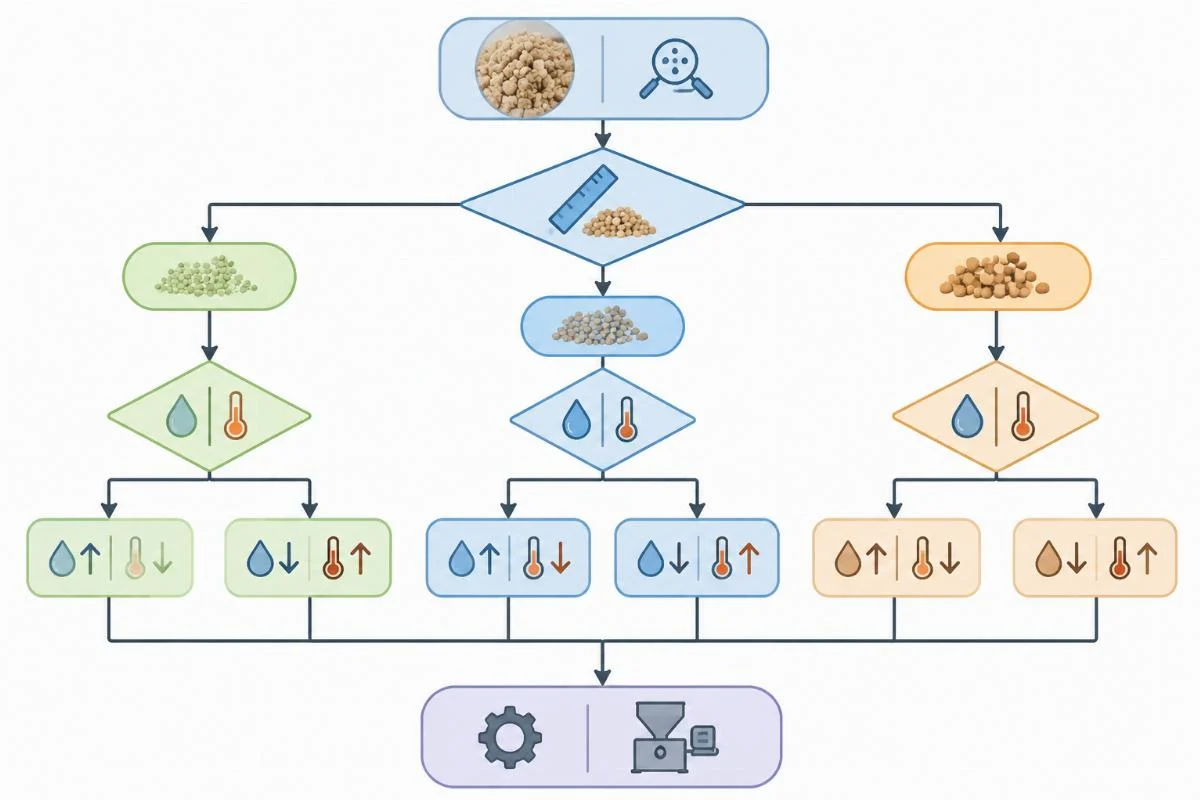
High-fiber formulas require coarse grinding paired with strong shear elements, while high-starch formulas need fine grinding and moderate shear to prevent nutrient degradation.
The screw configuration is the mechanical heart that interacts with your raw material particle size fish feed. You cannot use a one-size-fits-all screw profile.
Step 1: Analyze the Formula Composition
Determine the starch and fiber ratios. High-starch recipes (like those using wheat flour or cassava) gelatinize easily. High-fiber recipes (using rice bran or soybean hulls) require intense mechanical work to break down cell walls.
Step 2: Select the Grinding Baseline
For high-starch, aim for a finer raw material particle size fish feed to ensure rapid, uniform gelatinization. For high-fiber, a slightly coarser grind is acceptable, provided the extruder can handle the mechanical breakdown.
Step 3: Configure the Screw Elements
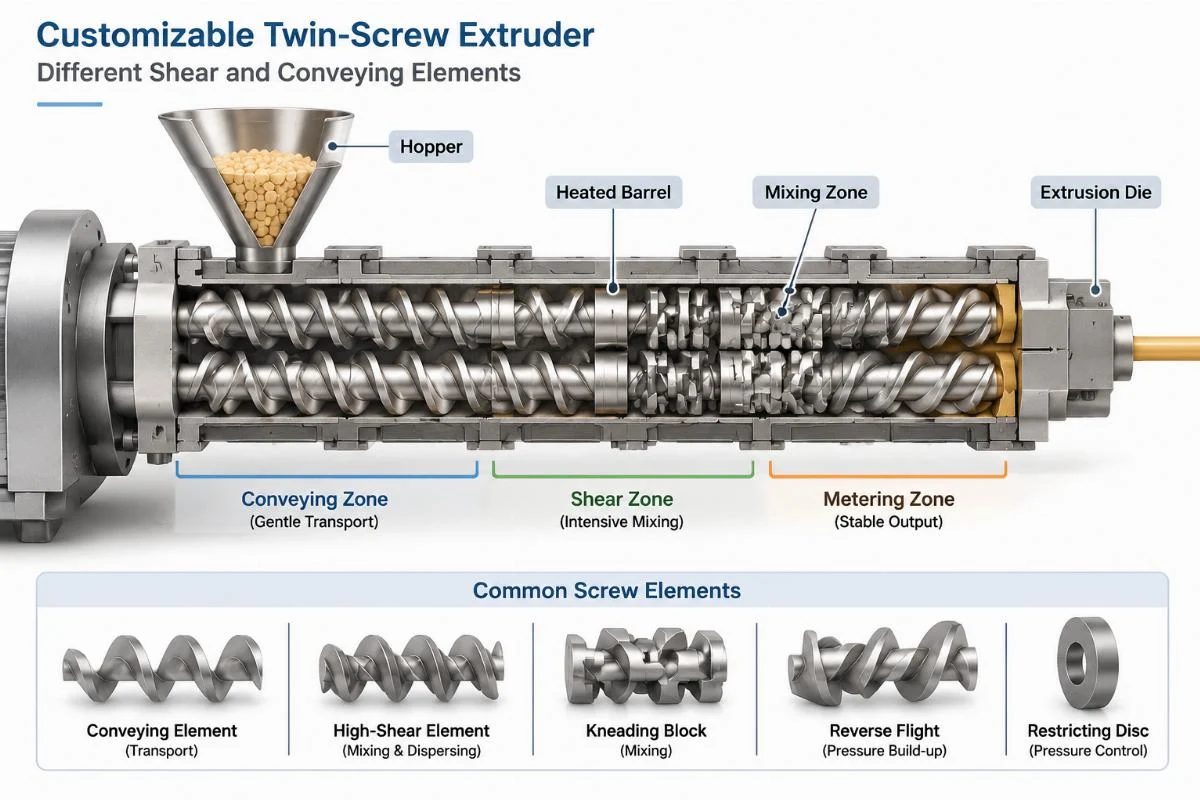
This is where precision matters. For high-fiber, you need conveying elements followed by intense kneading blocks to generate the shear force required to reduce the particle size inside the barrel. For high-starch, excessive kneading blocks will cause the overheating mentioned earlier. Use moderate shear elements to mix and gelatinize without destroying the starch structure.
This is exactly why Meiteng’s DS series twin-screw extruders are engineered with fully customizable screw combinations. Whether you are running a delicate high-starch floating feed or a rugged high-fiber sinking feed, the DS70 and other models in the series allow you to rearrange the screw elements to match the exact raw material particle size fish feed you are processing. The precise temperature control systems integrated into the barrel zones work in tandem with these screw profiles, ensuring that the shear heat is managed perfectly.
How to Calibrate Temperature and Moisture for Stable Sizing?
Precise zone temperature control and preconditioning moisture adjustment are critical for maintaining uniform pellet expansion and preventing size drift.
Even with the perfect screw configuration and raw material particle size fish feed, thermal and moisture instability will ruin the pellet size.
Step 1: Map the Moisture Curve
Start at the preconditioner. The steam added here must hydrate the particles without making them sticky. The target moisture depends on the particle size; finer particles absorb water faster. Use a moisture analyzer to verify the preconditioned mash before it enters the extruder.
Step 2: Calibrate the Barrel Zones
Do not just set the temperatures and walk away. Verify the sensors. In my early debugging days, a drifted sensor caused massive quality issues. The temperature profile should generally increase from the feed zone to the metering zone, then drop slightly at the die zone to prevent flash boiling and surface rupturing.
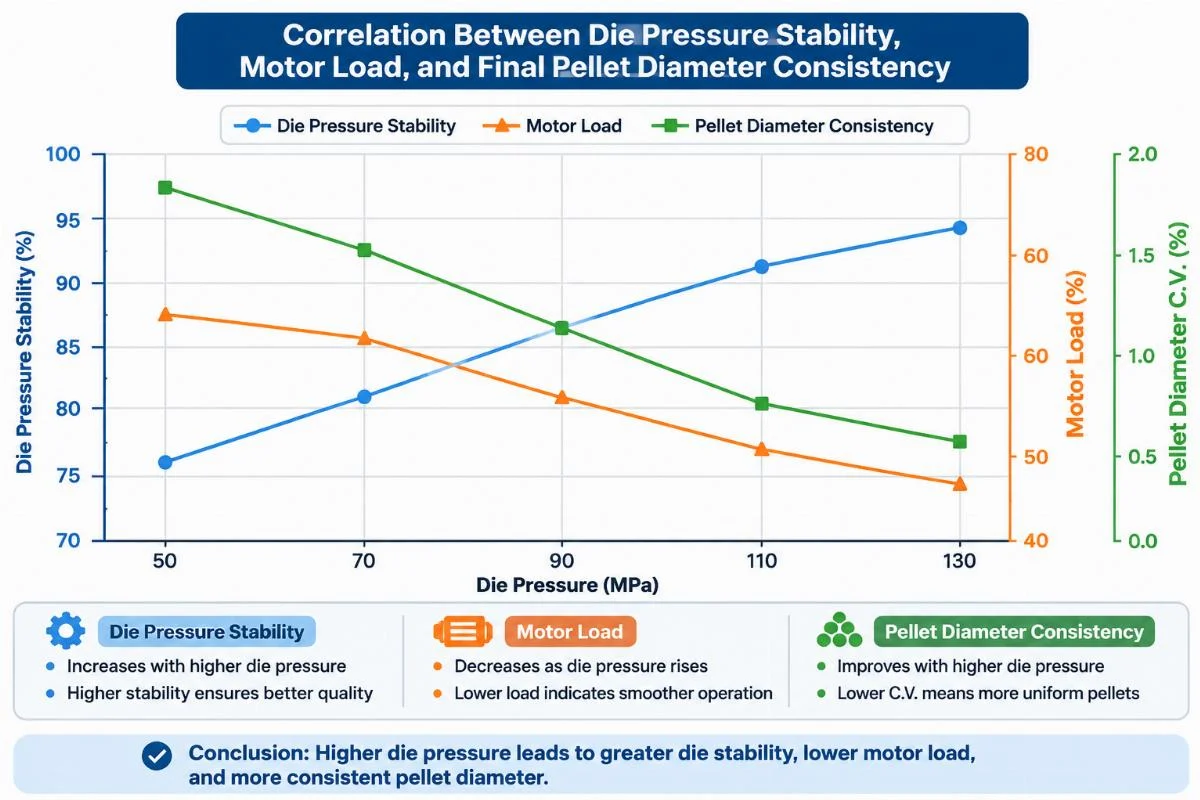
Step 3: Monitor Motor Load and Die Pressure
These are your real-time indicators. If the raw material particle size fish feed varies slightly from batch to batch, the motor load will change. A sudden spike in motor load indicates the material is too coarse or too dry, generating excess friction. Adjust the steam valve or slow the feeder to stabilize the pressure. Consistent die pressure is the only way to guarantee consistent pellet diameter.
Conclusion
Mastering raw material particle size fish feed requires a holistic approach that integrates grinding precision, screw configuration, and thermal management.
Controlling pellet expansion is not merely about selecting the right die plate; it is about orchestrating the internal shear forces, moisture levels, and gelatinization degree. By aligning your particle size distribution with the correct screw elements and maintaining strict calibration of your temperature and moisture parameters, you can eliminate irregular sizing, reduce powder rates, and produce premium aquaculture feed consistently.