Fish Feed Technical Article
DS70 Shrimp Feed Production: Fine Pellet Setup Guide from Manufacturer

Faster cutter speeds do not automatically yield finer pellets; mismatched parameters simply smear the die face and generate excessive dust.
Achieving uniform fine shrimp feed pellets on the DS70 requires precise synchronization of moisture content, barrel temperature, and cutter speed to prevent powder generation, rather than relying solely on blade sharpness.
When I was commissioning a feed line in Santa Catarina, Brazil, the moment we switched to the fine pellet template, the cutter speed failed to keep pace with the material flow. The output was essentially fine powder, and the client nearly rejected the entire batch. That specific failure forced a deep dive into the exact correlation between moisture conditioning and knife rotational dynamics. Having transitioned from workshop assembly to frontline technical support, I always start with on-site failures before breaking down the underlying parameter principles. This guide is built entirely on the practical lessons learned from batches ruined by improper fine pellet configuration..

Transitioning from coarse to fine pellet production demands a fundamental shift in how operators approach the DS70 shrimp feed extruder setup.
Why Does Your DS70 Produce Excessive Fine Powder?
Excessive fine powder is primarily caused by a mismatch between material flow rate and cutter rotational speed, not just dull blades.
When producing fine shrimp feed, the material exits the die plate at a specific velocity. If the cutter rotates too slowly, the strands smear across the die face before being cut, creating elongated tails that break into dust during cooling. Conversely, if the cutter spins too fast, it shatters the fragile strands upon impact. The root cause lies in the rheological properties of the dough and the mechanical synchronization of the cutting mechanism..
To resolve this, operators must follow a systematic diagnostic sequence rather than blindly replacing cutting blades.
- Observe the Die Face: Check for material smearing or accumulation around the die holes. Smearing indicates the cutter is too slow or the blade angle is incorrect for the specific die thickness.
- Monitor the Main Motor Load: A sudden drop in motor load often means the material is flashing through the die too quickly, outpacing the cutter.
- Evaluate the Cutter Blade Alignment: Ensure the blades are perfectly parallel to the die face. Even a slight tilt will cause uneven cutting on one side, generating localized powder.
- Adjust the Feed Rate Incrementally: Reduce the feeder speed slightly to allow the cutter to catch up, then fine-tune the cutter RPM to match the new extrusion velocity.
A Southeast Asian startup once faced severe powder issues during their initial DS70 shrimp feed extruder setup. They kept replacing blades, assuming wear was the culprit. After analyzing the motor load and cutter RPM, we discovered the feed rate was simply too high for the fine die configuration. By reducing the feed rate and synchronizing the cutter speed, the powder rate dropped noticeably, and pellet uniformity improved substantially..

How to Match Moisture Content and Barrel Temperature for Fine Dies?
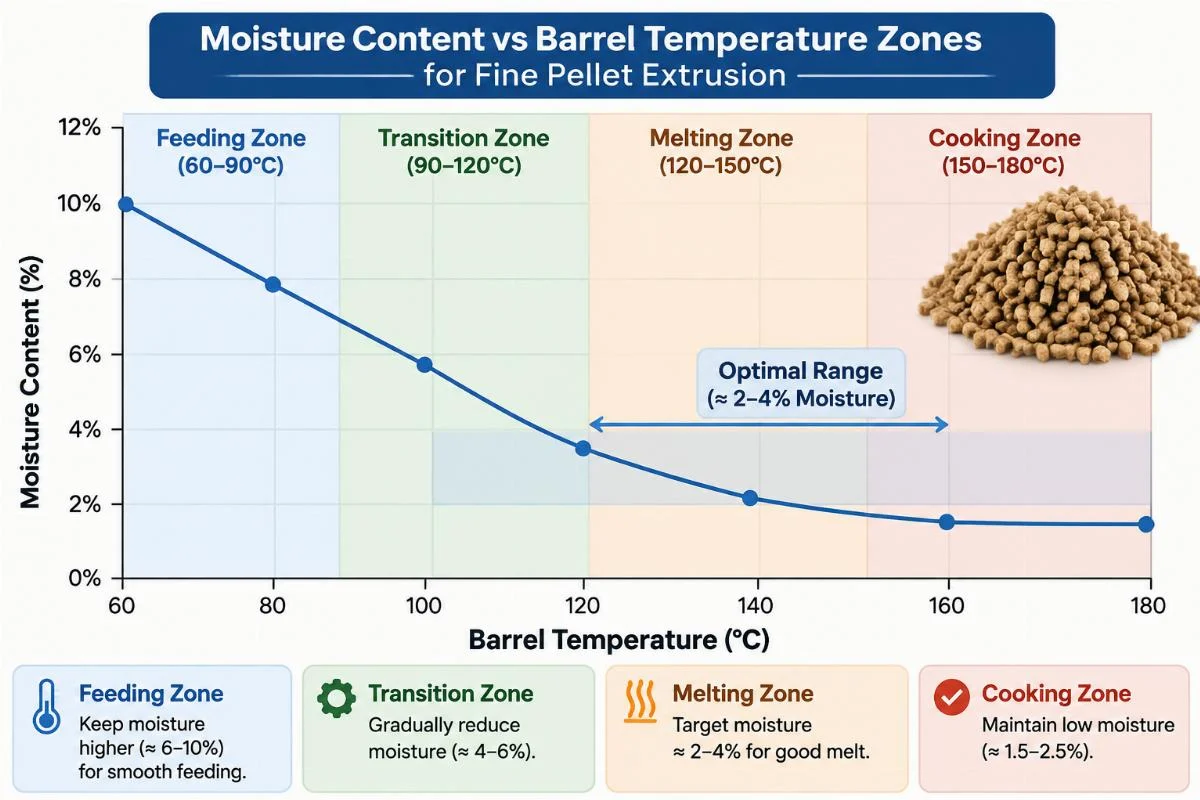
Fine pellets require stricter moisture control to prevent steam-induced fracturing, typically demanding lower moisture levels than coarse pellets.
Many operators assume that higher moisture improves binding and pellet durability. While this holds true for larger pellets, excessive moisture in fine dies causes a steam explosion effect as the material exits the die. The rapid pressure drop vaporizes the trapped water, shattering the delicate strands into fine dust before the cutter even engages..
Achieving the correct DS70 shrimp feed extruder setup for fine dies requires precise thermal and moisture management.
- Condition the Raw Material: Pre-condition the mix to ensure uniform moisture distribution. Inconsistent wet spots will cause localized steam explosions.
- Reduce Overall Moisture: Lower the final moisture content entering the extruder barrel. Fine dies require a drier dough matrix to maintain structural integrity upon decompression.
- Optimize Barrel Temperature Zones: Increase the temperature in the final metering zone slightly to ensure complete gelatinization without relying on excess moisture for binding.
- Monitor the Steam Injection: If using live steam injection, reduce the flow rate significantly when switching to fine dies to prevent over-hydration.
A Latin American plant struggled with pellet fracturing during their DS70 shrimp feed extruder setup. They were using the same moisture parameters as their coarse fish feed. By adjusting the moisture content downward and tweaking the barrel temperature profile, they eliminated the steam explosion effect. The pellets emerged clean and intact, drastically reducing the fines generated during the cooling process..
What is the Correct Cutter Speed and Feed Rate Synchronization?
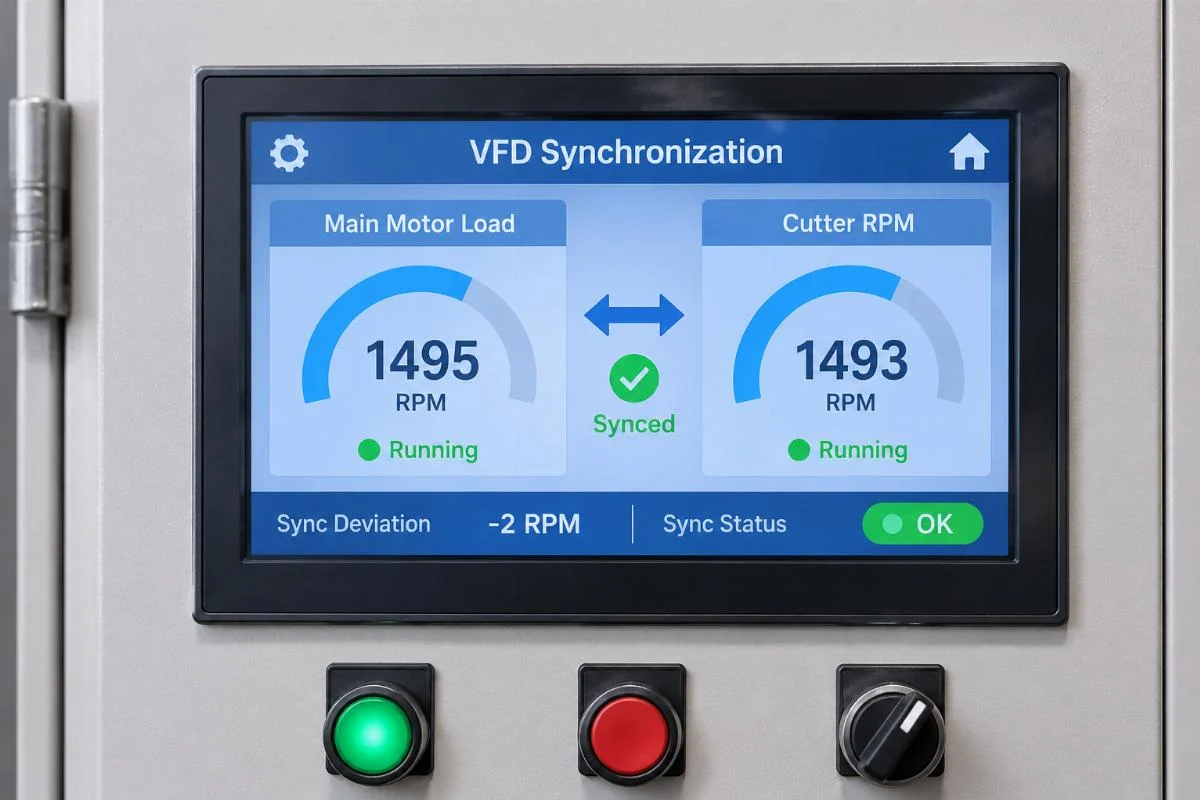
Cutter RPM must scale proportionally with the main motor load to ensure clean cuts without smearing the die face.
The most common misconception in the DS70 shrimp feed extruder setup is that the cutter speed is a fixed value for a specific die. In reality, the cutter RPM is a dynamic variable that must constantly adapt to the extrusion rate. The main motor load serves as the best indicator of the material flow rate inside the barrel..
Synchronizing these parameters requires a methodical approach.
- Establish a Baseline Motor Load: Run the extruder with the fine die installed and record the steady-state amperage of the main motor.
- Set Initial Cutter Speed: Start the cutter at a moderate RPM and observe the cut length and die face condition.
- Correlate Load with RPM: If the motor load increases (indicating higher back-pressure and flow), incrementally increase the cutter RPM. The goal is a one-to-one proportional relationship where the cutter clears the die face exactly as a new strand segment forms.
- Utilize Variable Frequency Drives: Ensure both the main motor and the cutter motor are controlled by synchronized VFDs to allow smooth, stepless adjustments.
During a commissioning project in Brazil, a client insisted on running the cutter at maximum speed to get the smallest possible pellet. This resulted in severe smearing and a massive increase in fine powder. By linking the cutter VFD to the main motor load feedback, we established a synchronized DS70 shrimp feed extruder setup. The cutter automatically adjusted to material fluctuations, maintaining a clean die face and consistent pellet length without generating excess dust..
How to Select the Right Die Plate L/D Ratio for Shrimp Feed?
An optimal L/D ratio ensures sufficient pressure for binding without causing excessive back-pressure and motor overload.
The die plate is the heart of the DS70 shrimp feed extruder setup. For fine shrimp feed, the length-to-diameter ratio of the die holes is critical. If the holes are too short, the material lacks the necessary compression to bind properly, resulting in weak pellets that crumble into powder. If the holes are too long, the back-pressure becomes excessive, overloading the main motor and causing the material to overheat and degrade..
Selecting the correct die geometry involves balancing these forces.
- Calculate the Required Pressure: Fine shrimp feed formulations require higher compression to achieve water stability. Determine the necessary pressure based on the recipe’s binding agents.
- Select the L/D Ratio: Choose a die plate with an L/D ratio that provides adequate compression without exceeding the extruder’s torque limits. A moderate ratio is typically ideal for fine diameters.
- Evaluate the Hole Pattern: Ensure the hole pattern distributes the material evenly across the die face to prevent localized high-pressure zones.
- Customize for Specific Formulations: Different shrimp feed recipes require different die geometries. A one-size-fits-all approach will always lead to suboptimal results.
This is where specialized manufacturing capabilities become essential. Meiteng provides tailored ring die design and customization specifically for the DS70 twin-screw extruder. By analyzing the specific rheological properties of a client’s shrimp feed formulation, Meiteng engineers the exact die plate L/D ratio and hole pattern required. This bespoke approach, combined with turnkey line integration and on-site operator training, guarantees that the DS70 shrimp feed extruder setup achieves maximum pellet uniformity and minimal powder generation from day one..

Conclusion
Mastering the DS70 shrimp feed extruder setup requires a holistic approach that balances moisture, temperature, cutter speed, and die geometry.
By understanding the rheological behavior of the dough and synchronizing the mechanical parameters accordingly, producers can eliminate excessive fine powder and achieve uniform, high-quality shrimp feed pellets. Proper configuration not only improves product quality but also maximizes the efficiency and lifespan of the extrusion equipment.